Prompt #13: January 2, 2014

Happy New Year!

Short on time while the holiday bells of family, friends and parties are still ringing, I have been writing snatches and snippets, but no real poems. Then! I stumbled upon a delightful little (and surprisingly powerful) form called the zip.

My friend Michael Dylan Welch, the current PL of Redmond, Washington, is a renowned poet, specializing in Japanese traditional forms. You can check out his work starting with his blog Graceguts. Michael shared the news earlier this week that the English poet, John Carley, passed away after a four-year battle with cancer. Michael challenged us, as a way to celebrate Carley’s life, to write a poem in the zip format he invented. Never having heard of a zip haiku, I was intrigued!

According to a 2001 article by Carley, a zip is “proposed as an analogue to the Japanese haiku, but uses a form more suited to the innate phonic and semantic qualities of English. The zip employs fifteen syllables, two weak pauses and one strong. The poem is centred on the caesura.

What could be better. Short poems for the crazy holiday season, or those crazy days in my PAD project when I am stuck at work late, exhausted, grumpy, etc. And a “real” form. So, I took up the challenge. I’ve written two in the past two days, and whether they are good or not, only time will tell. I love them. The first is a moment remembered from my daughter’s beach party and the second is a reflection on my mother’s upcoming birthday in Maine.

Write your own!!!

#1

making faces     around the fire
beer bottles      marshmallow smoke

# 2

    January      glittering blue and white
the shape of     windows

Prompt No. 12 – Late December, 2013

December is a busy time. I haven’t been keeping up very well with my intention to write a poem a day, but I have managed at least to write down a “poem starting point” each day that I haven’t written a poem draft.  I’ve overheard things, I’ve jotted down lines others have used in letters, Facebook posts, song lyrics. The days between December 20 and yesterday, December 28, all have bits of poems attached to them, like lint or coins you might find in a boy’s pocket. Or like bread crumbs you might follow out of a deep forest, back into the light of January and the post-holiday time/space continuum.

Last Thursday, December 26, 2013, I missed posting a prompt here. I knew I wasn’t going to do it; exhausted from Christmas, still in a Christmas coma, you might say, so when I overheard a friend say something on the phone that captured my attention, I wrote it down: “Tell her to make me something sour.” It’s a great line, and it has been drifting up through my consciousness into what might still become a poem. Time will tell.

There is a fine tradition of using snatches of conversation in poetry, the practice of “found poetry.” Defined as the “literary equivalent of a collage,” a found poem can be made of anything originally created, written or spoken by someone not the poet. Most found poetry is based on other writing, but my findings often come from what I hear other people say. It’s just another way into the poetic imagination, in through the ear, in through the eye.

Several found poems that I like are these:

Found Poem” by Howard Nemerov. In this poem, Nemerov has taken a fact from the census and written an expansion/exploration of it, creating a poem from a found starting point.

National Laureate” by Robert Fitterman. I have read that this poem is constructed from sayings made by poets laureate from all the states that have them. Fitterman has only arranged them and given them a title, thus provided his context and point of view. The found texts are unchanged.

A warm and witty poet, Ron Padgett, writes a great essay about the gimmicky nature of this “form,” and includes several excellent examples. I like Padgett’s stance against the subdivisions of poetry into serious (meaningful) and not (gimmicky), and the way he argues against the “must-ness” of poetry. “Self-expression is therapeutic and flashy technique is entertaining, but neither is necessarily good writing. So don’t let anyone hornswoggle you into thinking you should teach one to the exclusion or detriment of the other!”  Of course he is right. Good writing is not only about the form nor is it only about the intention of the poet, although both of those should play a role.

Your challenge is to write a found poem. Spend the day listening and looking; jot down lines that you find — jot them down exactly as they appear. Write any notes that you might like to help you remember the context. Or, don’t bother, and let the words exist without their original context and see how they will newly inspire you. Then, sit at your desk, with the found language arranged around you and see what happens.

Find yourself some merry little poems in the New Year. I’ll be seeing you in all the familiar places in 2014.

(And in case your tired of poetry, try Google-ing “gimmicks” and just watch the strange images flow by… maybe there’s a poem in there…)

Image

Prompt No. 11, December 19, 2013

It’s hard to remember to write a poem a day during the holidays. There is so much commotion. My daughter came home from college today, her boyfriend and my son are with her in the kitchen, making so much noise! I need quiet to write poems. So I came upstairs, sat down and started with “I need a poem.” Then, a surprising poem flowed right out of my pencil. A gift. A perfect poem for the darkness in my cold heart, the shrinking part of my soul that cowers around the children — they are so alive!

While thinking about how to write a poetry prompt that might replicate this experience, I searched the internet for “noise” poems and “winter darkness” poems. Here are a couple that might inspire you.

  • Noise Day” by Shel Silverstien. A funny lighthearted poem. Rhymes and bounces.
  • Phantom Noise” by Brian Turner. A dark edgy poem about PTSD and noise and probably tinnitus. Lyrically beautiful.
  • The Academy of American Poets has a whole list of poems for winter.
  • Emily Bronte’s “Spellbound” has a haunting urgency to it — as is she can’t take shelter from the coming storm because she must write her poem instead. Something about winter slows us down, frightens us. And yet we must keep living.
  • Annie Finch writes eloquently about Winter Poetry on the Poetry Foundation’s website, presents a sampler of winter poems, and includes a poem of her own, called “Winter Solstice Chant.”  You can hear her read it there, which is a delight.

One of the ways to help yourself along, if you are feeling it hard to find poems in your life right now, is to repeat lines. Annie Finch’s poem repeats one line twice.

“Winter Solstice Chant” by Annie Finch

Vines, leaves, roots of darkness, growing,
now you are uncurled and cover our eyes
with the edge of winter sky
leaning over us in icy stars.
Vines, leaves, roots of darkness, growing,
come with your seasons, your fullness, your end.

My draft poem, which I’m calling “I Need A Poem” (for now) uses a repeating stanza form, repeats the first words in the fourth and fifth line of each stanza, and also repeats one line through all three stanzas. I didn’t set out to write a poem in this form, but sometimes the content finds its own form during the writing. This is also a gift to a tired and overwhelmed poet. Overwhelmed with holiday noise. A repeating element in a poem is soothing. A chant. A song.

I’ll share it with you here, but be sure to look for the handwritten draft and other related images on Tumblr.

“I Need A Poem”

I need a poem
the kids are so noisy
the kids are so happy
from NY and Oregon
from Germany

I’ve forgotten about yesterday
I need a poem
the kids are so happy
cooking omelets and lentil soup
cooking together

tomorrow will be darker
I’ve forgotten about yesterday
the kids are so happy
yelling toward Solstice
yelling up the light

Your challenge is to write a poem about the dark. Think about what it means to be in the dark, what it means to be in the light. Is one place quiet or noisy? What is noise on the inside like? Why do you feel quieter in the winter? Why is the light so loud? Make it easy on yourself and repeat lines. You can copy my stanza format if you want. It’s nothing special. But it worked!

Prompt No. 10 for Dec 12, 2013

12/12/13. That’s the kind of number that makes me think of my dad.

If you were following me here you might have wondered why there was no 12/12 prompt. Or, if you were following on Facebook, you might have noticed that I explained I was busy at work and I offered you a lovely Persian poet to read instead. In any case, I’m a couple of days late, it’s true, and I’m sorry if you were counting on me. But, I’m guessing you weren’t. Who are you? And I hope you liked Ahmad Shamlou (in Farsi).

The post I planned for Thursday, is a warmup exercise. I call it “Color Warm Up for Writer’s Block.” We all have days when we’re too tired, too cranky, too overwhelmed, too busy. The holidays are busy times, whether you are warming up Hanukkah leftovers or  thinking that you only had 2+ weeks until Christmas. Or maybe you’re planning a Winter Solstice party and there’s just not time to write a poem, for crying out loud! Or, maybe you’re really blocked — the stress has gotten under your skin and even though you have time and want to write, there is nothing there. This prompt is what I turned to this week, because I was overwhelmed, and it made me happy, it made me very nostalgic, and I eventually got a tiny poem.

“Color Warm up for Writer’s Block” is very simple. Pick a color. Write it at the top of a piece of paper. Then list all the things you can think of that are that color. For example: Brown. Sanka brown. Age spots on my hands brown. Picture frame brown. Picture frame around a child’s drawing brown. Picture frame around a child’s drawing of a moth brown. Tree bark brown. Desert rock brown. Desk drawer brown. Wastebasket brown. It doesn’t work if you don’t use the color word in each image. The color becomes part of a breath, or a mantra. It keeps you focused on the color and you are more likely to pick objects speaking from your unconscious. Hence, the block-breaking power!

Notice how the emotion of the color changes as you work your way through the strange list you are making. Bulletin board brown. Cat paw brown. My mother-in-law’s rocking chair brown. Broken compost bin boards brown.

Notice that there is a story in some of the things you name, a story you wouldn’t have seen if you hadn’t been looking at the objects through this artificial lens.

Let a poem drift up through the objects on your list. The color you have been looking at may be in the poem, or not.

Old rocking chair
the coffee in my cup
is the same color as her hands

I hope you’ll find a chance to use this prompt this season. Give yourself a break. Don’t try to write the best poetry of the year; just notice what color the paper is.

Prompt No. 9 for 12/5/13

Hello Cupertino! Today’s prompt is not based on the poem I found myself writing today (strange and personal and not ready for prime time) but on a very special form of poetry called the pantoum.

The Poetry Foundation defines a pantoum as “a Malaysian verse form adapted by French poets and occasionally imitated in English. It comprises a series of quatrains, with the second and fourth lines of each quatrain repeated as the first and third lines of the next. The second and fourth lines of the final stanza repeat the first and third lines of the first stanza.” You can browse their site for poems written in this form. Contemporary and still emerging poets publishing in this form today include Natalie Diaz, Evie Shockley and the current U.S. Poet Laureate, Natasha Trethewey.  The Academy of American Poets also discusses the pantoum and offers examples. Many poets of a generation ago such as Carolyn Kizer, John Ashbery, Donald Justice and Anne Waldman have written in the form.

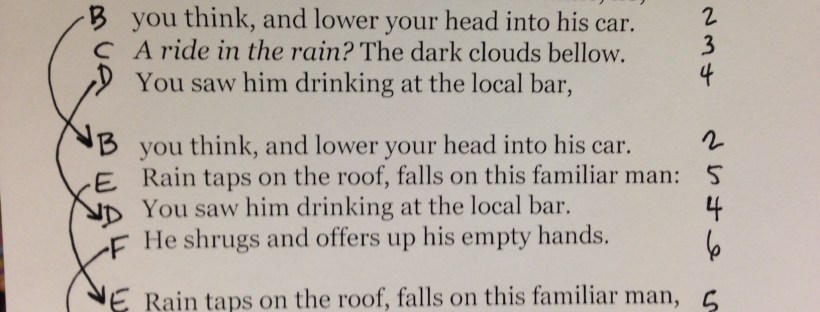
While it might seem daunting, I think writing in a form is often easier for novice poets, because the form tells you what to do. In this case, the form says: write four lines, then re-use two of them. Then re-use two more. Keep going until you get bored or run out of ideas for new lines. Then stop. I’m not asking you to write a great pantoum; that comes with experience (and luck sometimes) but is not your challenge today. Today I challenge you to try and see what comes. The attached photo shows how the line repetition works.

I am currently writing a pantoum that I started on Tuesday. I’m adding new stanzas, new lines, new ideas a little at a time, as the days go by. This kind of poem is also fun to write with a partner, so give that a try, if you are feeling adventurous. As always, I’ll put up my poem draft and associated images on Tumblr A Lane of Yellow this weekend.

And if you’re still on the fence, start with these two lines and see where they lead you:

December is a colder and darker month
The sky is black more than it’s blue.

Prompt No. 8 for 11/28/13

“Thanksgiving Mad Libs Poem”

This week’s prompt is coming a day early, rather than a day (or two) late. I hope you’ll write a poem this weekend, after eating, relaxing, enjoying family. But I may be the only one who will write one tomorrow. So here’s the prompt for Thursday 11/28/13. I’m calling this the “Thanksgiving Mad Libs Poem.” If you don’t remember what Mad Libs are (or never knew the pleasure of them as a kid) check out this site for an introduction/review. Apparently there are Mad Libs books for Christmas, Easter, Valentine’s Day — but none for Thanksgiving. I’ve used Mad Libs to teach poetry in the past; kids like them and their focus on words is a good warmup exercise for a stubborn class. But this time, I’m creating a poem using Mad Libs idea to create a prompt. Here’s how it works.

Fill in the blanks with words:
Favorite color ______________
Name a kitchen appliance ______________
Name a vegetable ______________
Name a state in the United States ______________
Name a transportation vehicle/mode of transportation ______________
Name a fruit ______________
Name a kind of monster ______________
Name a member of your family who is not coming for Thanksgiving ______________
Name something you like to do in November ______________
Name a type of ball ______________
Name something that smells really good ______________
Name something furry ______________
Name a sound that weather makes ______________
Name a different color ______________
Name an article of clothing ______________
What is your name? ______________

After you’ve done this, get a piece of paper and start writing “I am thankful for -” and then use the words from your list. The poem will work if you let your imagination hop around and if you really think why and how you might be thankful for the things you’ve listed.  If your list was written before you knew the poem would include being thankful for things, your words will be more interesting.

Here’s how I did it.

Favorite color green
Name a kitchen appliance refrigerator
Name a vegetable beets
Name a state in the United States Texas
Name a transportation vehicle/mode of transportation bicycle
Name a fruit persimmon
Name a kind of monster witch
Name a member of your family who is not coming for Thanksgiving my Mom 
Name something you like to do in November look at orange and yellow leaves
Name a type of ball ball of yarn
Name something that smells really good my husband making breakfast
Name something furry kittens 
Name a sound that weather makes wind banging against the house
Name a different color red
Name an article of clothing scarf
What is your name? Jennifer Brown

Now, here’s the “I’m thankful for” poem. It’s a long list poem, and I will probably continue to work on it. But for now, it’s a start and I hope an inspiration to you.

Falling for Persimmons and Yarn

I am thankful for green in the world. Green trees already here and green grass that we know comes with California rain.
I am thankful for refrigerators. The way they keep milk cold. The way they keep yogurt from getting moldy. They way my husband hides enchiladas in the small one and I find them.
I am thankful for beets. I wish we were eating some tomorrow. My dad loved them.
I am thankful for the people who live in Texas who might help that state to become less scary. I wonder if I’ll ever travel there again. I love the sound of the word “Texas” and hope that something wonderful will happen there soon.
I am thankful for bicycles. My yellow and black exercise bike is my new best friend.
I am thankful for persimmons. Oh my yum.
I am thankful for witches. I did not see this one coming and I even created the prompt. Witches have knowledge, wisdom, skinny legs and fabulous hats.
I am thankful for my mom. I wish she were coming to California to be with us now and will come again in the future. I am grateful that my entire family (except me) will be together in Massachusetts. I hope Mom has a good time and doesn’t end up doing all the dishes.
I am thankful for the wild colors of the trees where I live, especially ginkgoes.
I am thankful that balls of yarn exist in the world for kittens to play with and for me to knit with. I love yarn colors and textures.
I am thankful for the love of my husband and the way the house smells when he’s making breakfast for all of us, but especially if he’s teaching our son. Pancakes, French toast, sausage, bacon, eggs, waffles, banana bread, cinnamon rolls, you name it, it smells awesome. And even better when he’s making it with the love that lives in his heart.
I am thankful for our two furry kittens this year. I bet they will like turkey.
I am thankful for the wind that bangs against the house, even though it really scares me and I don’t like it. How to be thankful for something that’s necessary but frightening? An interesting predicament. How fun to get the word predicament into a poem.
I’m running out of steam so I’m going to be thankful now for scarves and for red at the same time: thankful for red scarves and hoping that my daughter will be wearing one when she gets off the plane tonight!
I am thankful for Jennifer Brown. For names that are common but unique in me. For names from my mother and father. For the self that is sometimes hard to love. Thanks.

Prompt No. 7 for Thursday 11/21/13

(I’m a day late, apologies!)

Think about high school – ah, the emotional time. Are you currently a student? Was it years ago? What is your favorite memory? What was your most horrible memory? If you could tell your high-school self something, what would it be?

This whole prompt was triggered when I started thinking about my son’s senior photo and his feelings about it — thinking about my senior photo – what was that hairdo? that goofy smile?

If you want to write to this prompt, get out a year book and look carefully at the photos — let the emotions from those years fill you up. Then write something using all five of your senses — what did your locker smell like, remember the voice of you secret crush sound like? Even if those images don’t make it into the final poem, they will ground your imagination in details.

A. E. Stallings’s poem, “Written on the eve of my 20th high school reunion, which I was not able to attend,” does this wonderfully, evoking both the terror of high school dreams and the shame that still haunts us years later. Especially these lines:

We wince at what we used to wear,
Fashion has made ridiculous the high hubris of our hair.
Heartbreak, looked at through the wrong end of distance’s glasses,
Is trivial, and quickly passes,
Its purity embarrasses us, its lust,
The way we wept because it was unjust.
Look for my poem on Tumblr (later this weekend).

Prompt No. 6

Poetry prompt for 11/14/13. I’ve been thinking about how to write a poem in response to Typhoon Haiyan, and I came upon Michelle Boisseau’s poem “The Fury That Breaks” in my May 2013 issue of Poetry. (See link for the poem online). The poem discusses fury, both as something that a group of people might have, but also personifies fury somehow, in a surrealistic way, as a being that can break people and trees apart into many pieces.

Try writing a poem about fury. If you like, just write about fury in your life or the life of someone else. Or, try personification: what does fury look like? Man or woman? Child or adult? What does fury wear, eat, say, think? Where does fury go and what happens next? What would you like to say to fury?

Enjoy the process and don’t be afraid of the feelings that might come out in words.

See my poem, poem draft images, and post your poem in response to the PAD blog, http://laneofyellow.tumblr.com/.