Prompt No. 12 – Late December, 2013

December is a busy time. I haven’t been keeping up very well with my intention to write a poem a day, but I have managed at least to write down a “poem starting point” each day that I haven’t written a poem draft.  I’ve overheard things, I’ve jotted down lines others have used in letters, Facebook posts, song lyrics. The days between December 20 and yesterday, December 28, all have bits of poems attached to them, like lint or coins you might find in a boy’s pocket. Or like bread crumbs you might follow out of a deep forest, back into the light of January and the post-holiday time/space continuum.

Last Thursday, December 26, 2013, I missed posting a prompt here. I knew I wasn’t going to do it; exhausted from Christmas, still in a Christmas coma, you might say, so when I overheard a friend say something on the phone that captured my attention, I wrote it down: “Tell her to make me something sour.” It’s a great line, and it has been drifting up through my consciousness into what might still become a poem. Time will tell.

There is a fine tradition of using snatches of conversation in poetry, the practice of “found poetry.” Defined as the “literary equivalent of a collage,” a found poem can be made of anything originally created, written or spoken by someone not the poet. Most found poetry is based on other writing, but my findings often come from what I hear other people say. It’s just another way into the poetic imagination, in through the ear, in through the eye.

Several found poems that I like are these:

Found Poem” by Howard Nemerov. In this poem, Nemerov has taken a fact from the census and written an expansion/exploration of it, creating a poem from a found starting point.

National Laureate” by Robert Fitterman. I have read that this poem is constructed from sayings made by poets laureate from all the states that have them. Fitterman has only arranged them and given them a title, thus provided his context and point of view. The found texts are unchanged.

A warm and witty poet, Ron Padgett, writes a great essay about the gimmicky nature of this “form,” and includes several excellent examples. I like Padgett’s stance against the subdivisions of poetry into serious (meaningful) and not (gimmicky), and the way he argues against the “must-ness” of poetry. “Self-expression is therapeutic and flashy technique is entertaining, but neither is necessarily good writing. So don’t let anyone hornswoggle you into thinking you should teach one to the exclusion or detriment of the other!”  Of course he is right. Good writing is not only about the form nor is it only about the intention of the poet, although both of those should play a role.

Your challenge is to write a found poem. Spend the day listening and looking; jot down lines that you find — jot them down exactly as they appear. Write any notes that you might like to help you remember the context. Or, don’t bother, and let the words exist without their original context and see how they will newly inspire you. Then, sit at your desk, with the found language arranged around you and see what happens.

Find yourself some merry little poems in the New Year. I’ll be seeing you in all the familiar places in 2014.

(And in case your tired of poetry, try Google-ing “gimmicks” and just watch the strange images flow by… maybe there’s a poem in there…)


Image

Prompt No. 11, December 19, 2013

It’s hard to remember to write a poem a day during the holidays. There is so much commotion. My daughter came home from college today, her boyfriend and my son are with her in the kitchen, making so much noise! I need quiet to write poems. So I came upstairs, sat down and started with “I need a poem.” Then, a surprising poem flowed right out of my pencil. A gift. A perfect poem for the darkness in my cold heart, the shrinking part of my soul that cowers around the children — they are so alive!

While thinking about how to write a poetry prompt that might replicate this experience, I searched the internet for “noise” poems and “winter darkness” poems. Here are a couple that might inspire you.

  • Noise Day” by Shel Silverstien. A funny lighthearted poem. Rhymes and bounces.
  • Phantom Noise” by Brian Turner. A dark edgy poem about PTSD and noise and probably tinnitus. Lyrically beautiful.
  • The Academy of American Poets has a whole list of poems for winter.
  • Emily Bronte’s “Spellbound” has a haunting urgency to it — as is she can’t take shelter from the coming storm because she must write her poem instead. Something about winter slows us down, frightens us. And yet we must keep living.
  • Annie Finch writes eloquently about Winter Poetry on the Poetry Foundation’s website, presents a sampler of winter poems, and includes a poem of her own, called “Winter Solstice Chant.”  You can hear her read it there, which is a delight.

One of the ways to help yourself along, if you are feeling it hard to find poems in your life right now, is to repeat lines. Annie Finch’s poem repeats one line twice.

“Winter Solstice Chant” by Annie Finch

Vines, leaves, roots of darkness, growing,
now you are uncurled and cover our eyes
with the edge of winter sky
leaning over us in icy stars.
Vines, leaves, roots of darkness, growing,
come with your seasons, your fullness, your end.

My draft poem, which I’m calling “I Need A Poem” (for now) uses a repeating stanza form, repeats the first words in the fourth and fifth line of each stanza, and also repeats one line through all three stanzas. I didn’t set out to write a poem in this form, but sometimes the content finds its own form during the writing. This is also a gift to a tired and overwhelmed poet. Overwhelmed with holiday noise. A repeating element in a poem is soothing. A chant. A song.

I’ll share it with you here, but be sure to look for the handwritten draft and other related images on Tumblr.

“I Need A Poem”

I need a poem
the kids are so noisy
the kids are so happy
from NY and Oregon
from Germany

I’ve forgotten about yesterday
I need a poem
the kids are so happy
cooking omelets and lentil soup
cooking together

tomorrow will be darker
I’ve forgotten about yesterday
the kids are so happy
yelling toward Solstice
yelling up the light

Your challenge is to write a poem about the dark. Think about what it means to be in the dark, what it means to be in the light. Is one place quiet or noisy? What is noise on the inside like? Why do you feel quieter in the winter? Why is the light so loud? Make it easy on yourself and repeat lines. You can copy my stanza format if you want. It’s nothing special. But it worked!

Prompt No. 9 for 12/5/13

Hello Cupertino! Today’s prompt is not based on the poem I found myself writing today (strange and personal and not ready for prime time) but on a very special form of poetry called the pantoum.

The Poetry Foundation defines a pantoum as “a Malaysian verse form adapted by French poets and occasionally imitated in English. It comprises a series of quatrains, with the second and fourth lines of each quatrain repeated as the first and third lines of the next. The second and fourth lines of the final stanza repeat the first and third lines of the first stanza.” You can browse their site for poems written in this form. Contemporary and still emerging poets publishing in this form today include Natalie Diaz, Evie Shockley and the current U.S. Poet Laureate, Natasha Trethewey.  The Academy of American Poets also discusses the pantoum and offers examples. Many poets of a generation ago such as Carolyn Kizer, John Ashbery, Donald Justice and Anne Waldman have written in the form.

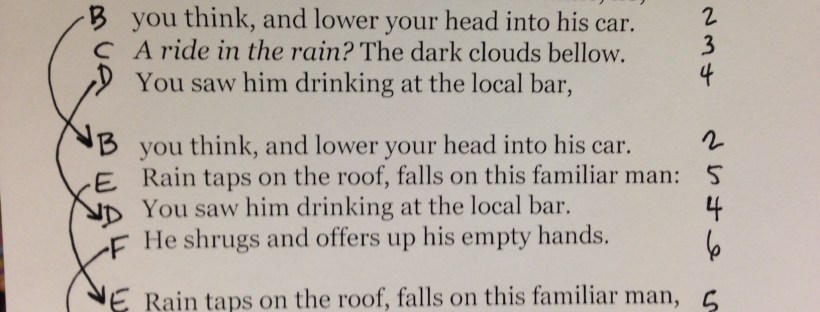
While it might seem daunting, I think writing in a form is often easier for novice poets, because the form tells you what to do. In this case, the form says: write four lines, then re-use two of them. Then re-use two more. Keep going until you get bored or run out of ideas for new lines. Then stop. I’m not asking you to write a great pantoum; that comes with experience (and luck sometimes) but is not your challenge today. Today I challenge you to try and see what comes. The attached photo shows how the line repetition works.

I am currently writing a pantoum that I started on Tuesday. I’m adding new stanzas, new lines, new ideas a little at a time, as the days go by. This kind of poem is also fun to write with a partner, so give that a try, if you are feeling adventurous. As always, I’ll put up my poem draft and associated images on Tumblr A Lane of Yellow this weekend.

And if you’re still on the fence, start with these two lines and see where they lead you:

December is a colder and darker month
The sky is black more than it’s blue.