Disobedience by A. A. Milne

For “Throwback Thursday”– and because I love this poem more than almost any other — I present to you, “Disobedience” by A. A. Milne.  My mother claims that I knew this poem by heart before I could read, certainly at two or three years of age. I believe her. It’s a great poem, and one that would appeal immensely to a child. And, most importantly, it sounds good and it’s very fun to read. Try it today! (The poem’s formatting is quirky, and I’m not going to try and fix it here –click through to The Poetry Foundation for a better look.)

Illustrations in the original book, When We Were Very Young, by the incomparable E. H. Shepard. In the illustration above, King John (and the Queen and the Prince) are saying they are very sorry to poor James.

Disobedience

By A. A. Milne

     James James
     Morrison Morrison
     Weatherby George Dupree
     Took great
     Care of his Mother,
     Though he was only three.
     James James
     Said to his Mother,
     “Mother,” he said, said he:
“You must never go down to the end of the town,
     if you don’t go down with me.”
     James James
     Morrison’s Mother
     Put on a golden gown,
     James James
     Morrison’s Mother
     Drove to the end of the town.
     James James
     Morrison’s Mother
     Said to herself, said she:
“I can get right down to the end of the town
     and be back in time for tea.”
     King John
     Put up a notice,
     “LOST or STOLEN or STRAYED!
     JAMES JAMES
     MORRISON’S MOTHER
     SEEMS TO HAVE BEEN MISLAID.
     LAST SEEN
     WANDERING VAGUELY:
     QUITE OF HER OWN ACCORD,
SHE TRIED TO GET DOWN TO THE END
     OF THE TOWN—FORTY SHILLINGS
     REWARD!”
     James James
     Morrison Morrison
     (Commonly known as Jim)
     Told his
     Other relations
     Not to go blaming him.
     James James
     Said to his Mother,
     “Mother,” he said, said he:
“You must never go down to the end of the town
     without consulting me.”
     James James
     Morrison’s mother
     Hasn’t been heard of since.
     King John
     Said he was sorry,
     So did the Queen and Prince.
     King John
     (Somebody told me)
     Said to a man he knew:
“If people go down to the end of the town, well,
     what can anyone do?”
 
    (Now then, very softly)
     J. J.
     M. M.
     W. G. Du P.
     Took great
     C/o his M*****
     Though he was only 3.
     J. J.
     Said to his M*****
     “M*****,” he said, said he:
“You-must-never-go-down-to-the-end-of-the-town-
     if-you-don’t-go-down-with ME!”

A. A. Milne, “Disobedience” from The Complete Poems of Winnie-the-Pooh. Copyright © The Trustees of the Pooh Properties, Curtis Brown Limited, London.

You can see more of my photos from my own books, at A Lane of Yellow (my Poem-A-Day image blog on Tumblr).

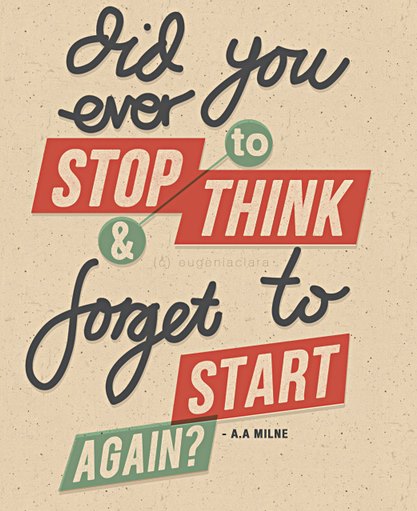
I like this following image, but I can’t confirm that A. A. Milne ever said it. Pooh talks about stopping to think, but not exactly this way. Does anyone know for sure? Of course, a good poem can always help you when you need to stop thinking.

stop to think and forget to start

Remembering civil rights history, when ‘words meant everything’

2014 is the fiftieth anniversary of the Civil Rights Act (1964). As part of a series of stories on this subject, NPR has run several stories and videos.

Remembering civil rights history, when ‘words meant everything’.

In this one, U.S. Poet Laureate Natasha Trethewey and Jeffrey Brown recently traveled from Mississippi to Alabama on a pilgrimage to witness the historical struggles and sorrows people faced during the civil rights movement. On their 100-mile journey, they examine the role of poetry in advancing the movement’s message for justice and freedom.

The video is about eight minutes long, and Ms. Trethewey only recites part of her moving and calmly horrifying poem “Incident,” about a black family looking through their living room curtains at a cross burning in their neighborhood. Here is the poem in its entirety. The form may be recognizable to some of you; it is a special stanza form called a pantoum.

I hope you’ll agree, as is mentioned in the video, that poetry is a form of sacred language, a way to speak (and sing) when you are afraid to speak.

Incident

By Natasha Trethewey

We tell the story every year –
how we peered from the windows, shades drawn –
though nothing really happened,
the charred grass now green again.

We peered from the windows, shade drawn,
at the cross trussed like a Christmas tree,
the charred grass still green. Then
we darkened our rooms, lit the hurricane lamps.

At the cross trussed like a Christmas tree,
a few men gathered, white as angels in their gowns.
We darkened our room and lit hurricane lamps,
the wicks trembling in their fonts of oil.

It seemed the angels had gathered, white men in their gowns.
When they were done, they left quietly. No one came
The wicks trembled all night in their fonts of oil;
by morning the flames had all dimmed.

When they were done, the men left quietly. No one came.
Nothing really happened.
By morning all the flames had dimmed.
We tell the story every year.

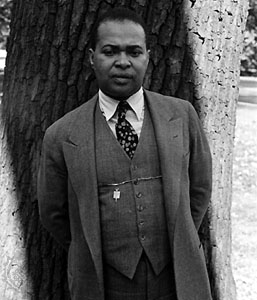
Gentle reader, you might find interesting another poem, by an African American poet, Countee Cullen, also named “Incident.” Poets like to do this, comment and copy and call out after one another.

Incident

By Countee Cullen

Once riding in old Baltimore,
Heart-filled, head-filled with glee,
I saw a Baltimorean
Keep looking straight at me.

Now I was eight and very small,
And he was no whit bigger,
And so I smiled, but he poked out
His tongue, and called me, ‘Nigger.’

I saw the whole of Baltimore
From May until December;
Of all the things that happened there
That’s all that I remember.

waltersk002

Pulitzer Prize Winner Vijay Seshadri

It’s been a busy day. I don’t have much energy for (even) poetry, Luckily, the 2014 Pulitzer Prize in Poetry was awarded today to Vijay Seshadri. As this NPR Book News article says, this winner was unexpected. I know nothing about Mr. Seshadri, other than he was born in Bangalore India, in 1954, and he must be a great poet. This should make him of particular interest to our Cupertino community. Here’s a biography of Mr. Seshadri from Poets.org and here is a poem of his, that speaks directly to our guilt and privilege, and the mysterious nature of our survival. I look forward to learning more about his poetry.

Survivor
by Vijay Seshadri

We hold it against you that you survived.
People better than you are dead,
but you still punch the clock.
Your body has wizened but has not bled

its substance out on the killing floor
or flatlined in intensive care
or vanished after school
or stepped off the ledge in despair.

Of all those you started with,
only you are still around;
only you have not been listed with
the defeated and the drowned.

So how could you ever win our respect?–
you, who had the sense to duck,
you, with your strength almost intact
and all your good luck.

Survivor

by Vijay Seshadri

We hold it against you that you survived.
People better than you are dead,
but you still punch the clock.
Your body has wizened but has not bled

its substance out on the killing floor
or flatlined in intensive care
or vanished after school
or stepped off the ledge in despair.

Of all those you started with,
only you are still around;
only you have not been listed with 
the defeated and the drowned.

So how could you ever win our respect?--
you, who had the sense to duck,
you, with your strength almost intact
and all your good luck.

– See more at: http://www.poets.org/viewmedia.php/prmMID/16670#sthash.UJ3y7UXY.dpuf

Survivor

by Vijay Seshadri

We hold it against you that you survived.
People better than you are dead,
but you still punch the clock.
Your body has wizened but has not bled

its substance out on the killing floor
or flatlined in intensive care
or vanished after school
or stepped off the ledge in despair.

Of all those you started with,
only you are still around;
only you have not been listed with 
the defeated and the drowned.

So how could you ever win our respect?--
you, who had the sense to duck,
you, with your strength almost intact
and all your good luck.

– See more at: http://www.poets.org/viewmedia.php/prmMID/16670#sthash.UJ3y7UXY.dpuf

The Passover Full Moon, Bei Dao and Alan Ginsberg

Tonight is a full moon. There’s also going to be a total lunar eclipse. Tonight is also the first night of Passover, which always starts with a full moon (I think). I tried to look this up on the internet and the answers to how to calculate Passover and Easter dates are very complicated and involved math and java script. Yikes! This is why I am a poet.

There are many poems about the moon. You might even say that the moon is the single most poetic thing around. I want to share some of these lovely poems with you.

  • Here’s a website dedicated to poems that have the phrase “full moon” in them.
  • Bei Dao, perhaps the most internationally famous living Chinese poet, is the nom de plum of Zhao Zhenkai. This poem, “Moon Festival” is mysterious to me, but perhaps my Chinese Cupertino readers will understand it better. I looked for a version in Chinese and could find nothing. That’s probably my fault, not the poem’s. (My favorite part of this poem is the trees applaud.)

Moon Festival
By Bei Dao
Translated by Eliot Weinberger and Iona Man-Cheong

Lovers holding pits in their mouths
make vows and delight in each other
till the underwater infant
periscopes his parents
and is born

an uninvited guest knocks at my
door, determined to go deep
into the interior of things

the trees applaud

wait a minute, the full moon
and this plan are making me nervous
my hand fluttering
over the obscure implications of the letter
let me sit in the dark
a while longer, like
sitting on a friend’s heart

the city a burning deck
on the frozen sea
can it be saved? it must be saved
the faucet drip-drop drip-drop
mourns the reservoir

  • This poem by Alan Ginsberg, “A Supermarket in California,” is a fantasy on walking around San Francisco, talking to Walt Whitman. Here’s the first crazy stanza:

What thoughts I have of you tonight Walt Whitman, for I walked down the sidestreets under the trees with a headache self-conscious looking at the full moon.

In my hungry fatigue, and shopping for images, I went into the neon fruit supermarket, dreaming of your enumerations!

What peaches and what penumbras! Whole families shopping at night! Aisles full of husbands! Wives in the avocados, babies in the tomatoes!—and you, Garcia Lorca, what were you doing down by the watermelons?

I hope you can see the full moon wherever you are and whatever you are doing tonight.

Poems for Palms

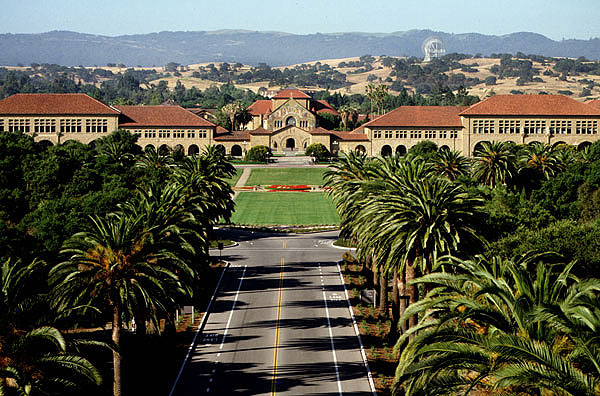
I always enjoy Palm Sunday, even now when I no longer attend church, and I think partly it’s because I grew up in California and palm trees have been ubiquitous and beloved for many years. When I was younger, Palm Sunday meant a day in church when children has a special job, taking all the palm leaves to the altar. Now, palm trees are mostly things I wonder at and walk or drive under — along Palm Drive at Stanford University, Palm Avenue in Cupertino, palm trees and their messy falling fronds in my own back yard.
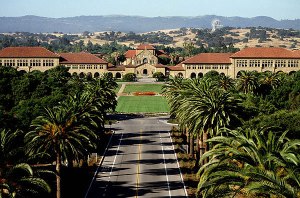
PalmDrive

I’m writing a poem today about palm trees, calling it “Palm Tree Sunday” but I wondered if there were poems about Palm Sunday — religious poetry that I could share here. And, of course, there are.

G. K. Chesterton wrote a beautiful poem about a mournful donkey, and only mentions Palm Sunday in passing, without naming the day. You have to be familiar with the story of Jesus entering Jerusalem on the back of a donkey to catch the allusion. Chesterton was an English poet, art critic and Christian apologist. He converted to Roman Catholicism from the Church of England and spent much of his time and energy as a writer with spiritual work. The poem here, “The Donkey” is a delightful poem on so many levels, and no matter what you believe about Jesus, the donkey’s sad, disrespected voice is familiar to anyone who has ever felt less than loved.

The Donkey

by G. K. Chesterton

When fishes flew and forests walked
And figs grew upon thorn,
Some moment when the moon was blood
Then surely I was born;

With monstrous head and sickening cry
And ears like errant wings,
The devil’s walking parody
On all four-footed things.

The tattered outlaw of the earth,
Of ancient crooked will;
Starve, scourge, deride me: I am dumb,
I keep my secret still.

Fools! For I also had my hour;
One far fierce hour and sweet:
There was a shout about my ears,
And palms before my feet.

The next poem I want to share is a contemporary verse about Palm Sunday written to delight children learning about the day in their church school. Andrew King has a wonderful blog full of his own poetry, much of it in response to the week’s lectionary. (Click through to his blog for an explanation.)

This poem, called “The Story of Palm Sunday (as told for the young)” is absolutely charming. What is not to love about a poem that rhymes “anointed” with “pointed” and remembers the glory of historical Jerusalem as “quite a blast” — I mean, this poet must have had a great time writing this. The rhythm is strong, the language alive. I love it. Here are several stanzas from the middle of the poem.

“He’s coming straight to Jerusalem’s gate,”
the folks were excitedly saying;
“Let’s get out there in the open air
and show the Romans for what we’ve been praying.”

They cut branches down and handed them round,
a symbol of joy and praising.
And they lined the way for Jesus that day,
palms and voices ready for raising.

Jesus, meantime, had his followers find
a young donkey on which he could ride.
He’d come to that place to show God’s saving grace,
that God’s on the sufferer’s side.

These photos are the closest I could find to what I remember.
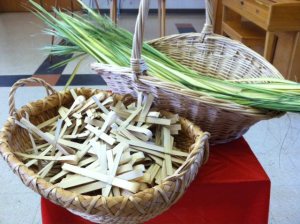
palm-sunday1 galleryImage.php

So, Happy Palm Sunday. Be you a believer in Jesus or not, I hope that you can believe in poetry with me today.

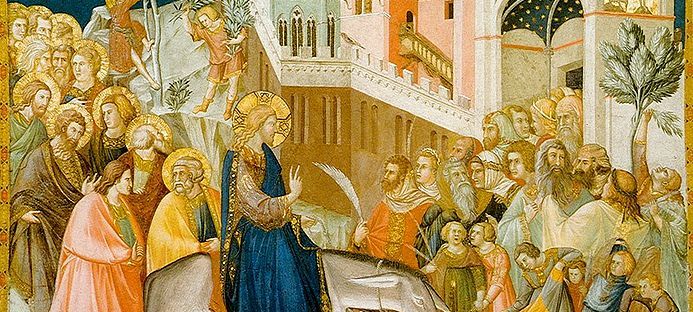
The painting at the top of the post is Entry of Christ into Jerusalem (1320) by Pietro Lorenzetti. Entering the city on a donkey symbolizes Jesus’ arrival in peace rather than as a war-waging king arriving on a horse.

A Poem from Nothing but Words : The Column Poem (PAD Prompt #27)

In honor of my daughter’s anthropology qualifying exams, which you can read more about in this Cupertino Poetry Exchange post, I wanted to write her a poem that celebrated anthropology. But, not being an anthropologist, I wasn’t really sure how to go about this. So, of course, I went to Wikipedia. I always start either there or at Stanford’s Green Library. General consumption of information that might be accurate or the deep deep scholarship of the ages. Sometimes you need one, sometimes the other.

So, Wikipedia defines anthropology nicely enough but didn’t give me much inspiration for writing a poem. Then I remembered a prompt/tactic/exercise I’ve taught and that I’ve also been taught by others (probably in the other order). Take a piece of prose (or write your own piece of prose) about a topic. Then circle 5, 7, 15, 31 of the best or most interesting words in the prose. Always an odd number. Don’t ask me why. Then put those words in a line down the center of the page in a single column and write whatever comes to you on both sides of those words. Voila, your poem. Like a column with wings.

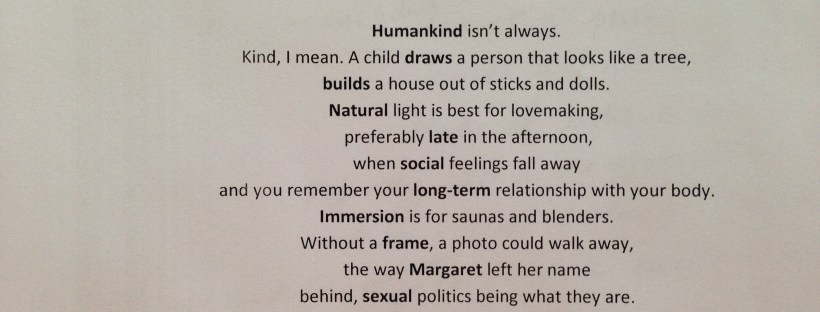
I took Wikipedia’s definition of anthropology, picked the words that spoke to me, and came up with this funky, silly, sexy, and rather delightful poem. I doesn’t have much to do with my daughter, except perhaps the last two lines. And it’s got 14 lines, so I didn’t even follow my own advice.

Here’s what the prose looked like and then the messy wing-y column first draft. Finally, the poem (at the top of the post).

Your challenge, if you want to write today, is to write prose, pick your favorite words, and then make your own “column poem.”

Anthropology Poetry

In honor of my daughter, who is this very moment taking her anthropology qualifying exam, I’ve found some anthropology poetry connections.

In this short essay, Robert Peake thinks about how poetry can be a kind of anthropology — the idea of “poet as anthropologist” — in contrast to the recently popular confessional poetry point of view — “poet-as-person-who-confesses.” The author makes the point that poets might be tired of gazing at their navels, and are now more likely to gaze at the navels of others.

“[…] American poets are no less united in the cause … to “extend the imaginative franchise”–with its power to renew our understanding of what it means to be human. It is in this pursuit that poetry and the actual science of anthropology intersect. At the end of postmodernism, having our ideas of objectivity and centrality blasted to bits by the Second World War, we are beginning to pick up the pieces.

But simply gluing them back together is no longer an option. Having examined our own little fragment ad nauseum through confession, we are finally beginning to relate more inquisitively to our own, and the other, shards. In what I hope history will regard as our current period of “late postmodernism” or perhaps “post-postmodernism,” we return in poetry to the one question a Google search can’t answer for us: what is it, this thing called “being human?”

And because I want to give my daughter (to whom I have mailed a copy of this poem) and you, gentle digital reader, a moment to slow down with a poem and consider what it means to be human, here is a wonderful mysterious poem I found, just for you.

Anthropology
By James Galvin

Remember the night you got drunk
and shot the roses?
You were a perfect stranger, Father,
even my bad sister cried.

Some other gravity,
not death or luck,
drew fish out of the sea
and started them panting.

The fish became a man.
The archer’s bow became a violin.
I remember the night you searched the sofa
for change

and wept on the telephone.
Some other gravity,
not time or entropy,
pulled the knife down for centuries.

The archers dropped their bows,
harmless as pine needles in the snow.
The knife became a plow
and entered the earth, Father.

Later it became a boat
and some other things —
It isn’t a dream but it takes a long time,
for the archer’s bow to become a violin.

James Galvin, “Anthropology” from Resurrection Update: Collected Poems 1975-1997. Copyright © 1997 by James Galvin. Copper Canyon Press, http://www.coppercanyonpress.org.

For future exploration:

(In case you came today to get a prompt to write a poem, read this related post.)

Poems about Healing

Poetry can help us heal. Mind and body. Today I offer the poem “Lying In Wait” by Rachel Hadas.

Lying In Wait

by Rachel Hadas

Lying in bed and waiting for the purple
bruises to fade from my arms,
I remember the grinding pebbles underfoot
when I gave in to the muscular embrace of the ocean.
Now I rest in the wash of what has been accomplished.
A shallow golden river is pouring itself over stones,
over this empty husk, scooped shell of waiting
for transformation. Also transportation:
I need a fresh itinerary now
a dismantled world is being reassembled;
new map of stars I gaze at from the cool
tank of silence where I lie back, bathe,
and wait for the purple to fade.

About the poet:

Rachel Hadas is Board of Governors Professor of English at the Newark campus of Rutgers University, where she has taught for many years. Her latest collection of poems is The Golden Road (2012). A new collection, Questions in the Vestibule, is in preparation.

Click through this link to the wonderful blog “Pulse-Voices from the Heart of Medicine” to read her poem and more like it. Today’s front page features a sweet haiku.

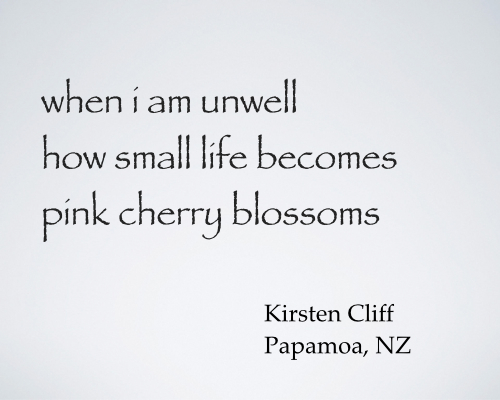
when_i_am_unwell_-_cliff_001

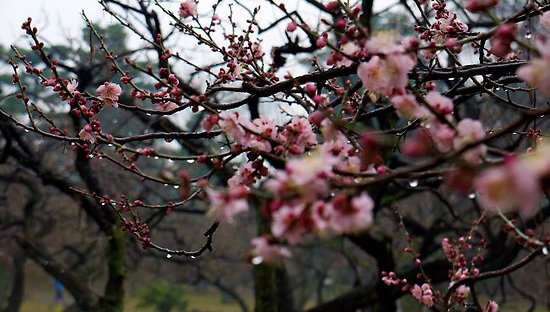
It’s raining in California today, but there are still blossoms on many of the trees. Take a moment to pause today and notice something that might heal your pain.

(Today’s photo by Ken Taylor)


Golf Poetry Through the Ages

In honor of my brother-in-law and my uncle, who both celebrate their birthdays today and love golf, I’m offering golf poetry on the Cupertino Poetry Exchange.

This New York Times article is a fascinating tale about the poetry written by golfers and golf enthusiasts. I have to say, I had absolutely no idea.

“People who wrote golf poetry were golfers, and they understood the perversities and intricacies of the game,” he added.

White’s book assembles 90 poems by 45 writers from England, Scotland and the United States, including himself. Among the highlights are works by the authors Arthur Conan Doyle and Rudyard Kipling, the golf course architect Robert Trent Jones Jr. and the sportswriter Grantland Rice.

Dr. Leon S White, the author of the book reviewed in the NY Times, Golf Course Rhymes, has a blog, at which you can read some of the most fun poems I’ve read all month. Here’s just a taste!

On Putting

When the greens were fast and freakish,
Once my putts were either weakish
Or absurdly strong.
Now I calmly snap my digits
For I play with Spaulding “Midgets,”
Not a putt goes wrong.

When a green’s too hard for others,
Have recourse to Spaulding Brothers!
Buy the perfect ball.
Architects may slope and ridge it,
But you’ll always hole a “Midget,”
And defeat them all.

Read the whole post in which Dr. White describes how this advertisement for Spaulding appeared in a 1914 issue of Golf Magazine and the poem’s relationship to Robert Frost.

Happy Birthday to my beloved family members and happy golfing to anyone who’s out enjoying spring this weekend.


“For I will consider my Cat Jeoffry”

Poems about cats. (We already talked about poems and dogs, discussing Mary Oliver and Billy Collins.) I love cats. I don’t know that there are as many poems about cats, many poets being dog people, but that’s okay. I know of a few.

Today on The Writer’s Almanac, Garrison Keillor read a poem called “The Cats” by Ann Iverson. It’s got the right attitude for a poem about cats, “To find yourself so remarkable /  all the day long.” That is what cats do. That’s what got me started thinking about cat poetry. I found on the Poetry Foundation’s website an entire page about Cat Poems. The list includes “The Owl and the Pussy-Cat” which I lauded here earlier this week, several other children’s rhymes, some very funny stuff, including the concrete poem (poem in a shape) “Magnificat. Brave Cat At Snifter Fishbowl” by George Starbuck (see image below), and some fine work by Sylvia Plath and Ted Hughes, that English couple with all the marriage troubles.

But by far my favorite cat poem, and a very famous one indeed, is the section from Jubilate Agno written by Christopher Smart that begins “For I will consider my Cat Jeoffry.” You can read all about Mr. Smart at the Poetry Foundation, and many other places, but I encourage you, if you’re tired and need a lift, to read the poem about his cat. There is nowhere else in the English language a more beautiful hymn to a cat, and to their magical spiritual heavenly ordinary lives. The poem is too long to reproduce here, but you can find it here. And just a taste —

For first he looks upon his forepaws to see if they are clean.
For secondly he kicks up behind to clear away there.
For thirdly he works it upon stretch with the forepaws extended.
For fourthly he sharpens his paws by wood.
For fifthly he washes himself.
For sixthly he rolls upon wash.
For seventhly he fleas himself, that he may not be interrupted upon the beat.
For eighthly he rubs himself against a post.
For ninthly he looks up for his instructions.
For tenthly he goes in quest of food.
Here is George Starbuck’s poem.  The cartoon (check out the awesome blog post of his life) of Christopher Smart and Jeoffry is by Paul Bommer.
 20601568-000