Poetry About Race : Not My Voice Today, but Claudia Rankine’s

Writing about race as a white woman. Wanting to do the right thing, and yet falling short. Second guessing myself. Saying something stupid. Argh!

Rather than even go there today, I’m offering fans of the Cupertino Poet Laureate an essay by Claudia Rankine and Beth Loffreda, called “On Whiteness and The Racial Imaginary: Where writers go wrong in imagining the lives of others.” I found this excerpt (adapted from the foreword to The Racial Imaginary, a collection of essays edited by Claudia Rankine and Beth Loffreda, available from Fence Books.) on Literary Hub, my new favorite place.

This is my first favorite quote: … our imaginations are creatures as limited as we ourselves are. They are not some special, uninfiltrated realm that transcends the messy realities of our lives and minds. To think of creativity in terms of transcendence is itself specific and partial—a lovely dream perhaps, but an inhuman one.

And this is my second …. Part of the mistake the white writer makes is that she confounds the invitation to witness her inevitable racial subjectivity with a stigmatizing charge of racism that must be rebutted at all costs. The white writer, in the moment of crisis, typically cannot tell the difference. What a white person could know instead is this: her whiteness limits her imagination—not her reader’s after the fact. A deep awareness of this knowledge could indeed expand the limits—not transcend them, but expand them, make more room for the imagination. A good thing.

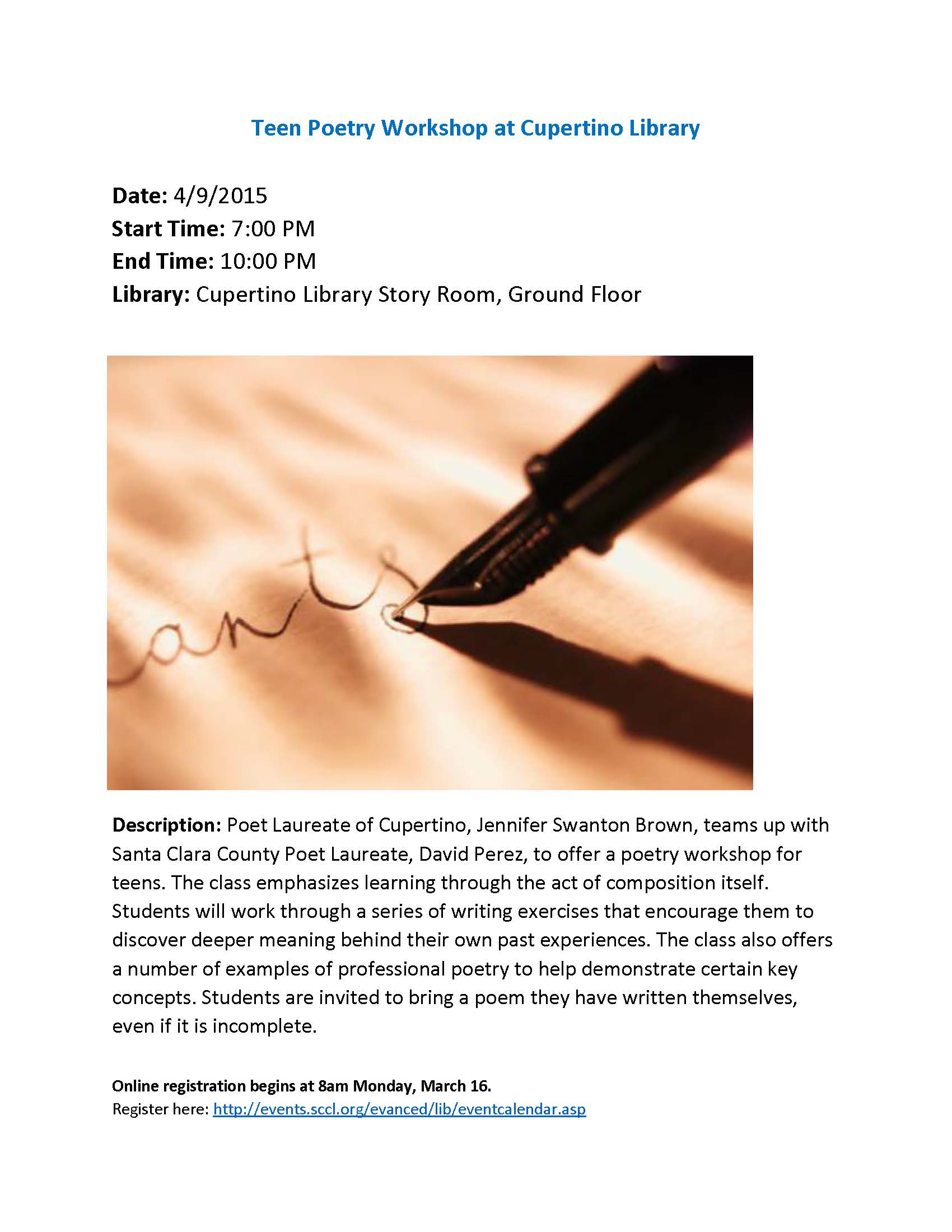
Poetry Workshop for Teens at Cupertino Library

Please join me and my friend David Perez, the current Santa Clara County PL, this Thursday evening at the Cupertino Library for a poetry workshop. Celebrate National Poetry Month with us!

I’ll warm up the crowd with a poetry warm up full of colors and David will run his part of the workshop in his inimitable way.

Bring a poem of your own, or come ready to write and hang out.

Register at the library website at this link. Hope to see you there!

Teen Poetry Workshop at Cupertino Library

Marliyn Chin, “How I Got That Name”

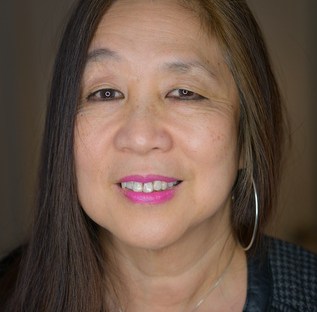
To continue with poetry engaged with questions of race, I present to you Marilyn Chin, a wonderful poet, novelist, and voice for justice. She is the winner of the prestigious Anisfield-Wolf Book Award for Poetry, a national prize for literature that confronts racism and examines diversity, which includes Martin Luther King, Jr., Malcolm X, Alex Haley, Junot Díaz and Toni Morrison among its winners.

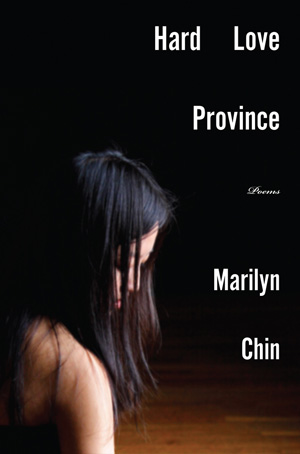
Chin was born in Hong Kong and raised in Portland, Oregon. Her books have become Asian American classics and are taught in classrooms internationally. Marilyn Chin has read her poetry at the Library of Congress. She was interviewed by Bill Moyers’ and featured in his PBS series The Language of Life and in PBS Poetry Everywhere. (I copied this stuff directly from her website. She has a gorgeous website. Her book covers are gorgeous.)

Hard Love Province 9_10.indd

I went looking for her work because I remember this poem, “How I Got That Name” from a class, or a listserve, or something in my past. Once you read this poem, you never forget it. You can read it at http://www.poets.org with her biography. You can also find her at the Poetry Foundation, with another of her amazing poems, the astounding (visually and auditory) “Brown Girl Manifesto (Too)” — that one you have to read out loud. Here’s one blogger’s analysis of it, and whether it’s racist against white people!

The poem I’m sharing today, “How I Got That Name” contains some playful, caustic, brutal, hysterical and terrifying imagery. For example:

History has turned its stomach
on a black polluted beach—
where life doesn’t hinge
on that red, red wheelbarrow,
but whether or not our new lover
in the final episode of “Santa Barbara”
will lean over a scented candle
and call us a “bitch.”
Oh God, where have we gone wrong?
We have no inner resources!

(Please note the reference to William Carlos William’s famous poem — a poem that describes a reality Chin doesn’t feel welcome to, welcome in…. I’m going along horrified, until I get to that last bit, “We have no inner resources!” — then I have to laugh out loud.)

And then this bit, where an Asian-American woman, writes with perfect seriousness:

She was neither black nor white,
neither cherished nor vanquished,
just another squatter in her own bamboo grove
minding her poetry—

You really have to read this poem several times to catch all the references.

In case these little snippets don’t tempt you to read further, here’s a line from “Brown Girl Manifesto (Too)” —

Succumb to the low-lying succubus     do!

Chin’s voice is wide-ranging, rhythmic, musical, self-deprecating, funny, exploratory and absolutely poke-you-with-a-stick unforgiving. I hope you like it as much as I do.

Langston Hughes, “Dream Variations”

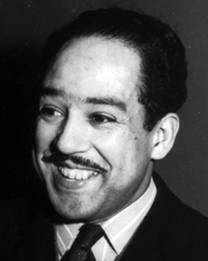
I have stated my desire to celebrate National Poetry Month by seeking and sharing poems about race. I love Langston Hughes’ work, but I think my reasons for sharing the poem I did on April 1 were more about my affinity for his youthful yearnings than about my promoting his poetry of race. To correct that, I offer today, his lyric of black and white, “Dream Variations.” Thank you to The Academy of American Poets.

Dream Variations

Langston Hughes, 19021967
To fling my arms wide
In some place of the sun,
To whirl and to dance
Till the white day is done.
Then rest at cool evening
Beneath a tall tree
While night comes on gently,
    Dark like me—
That is my dream!

To fling my arms wide
In the face of the sun,
Dance!  Whirl!  Whirl!
Till the quick day is done.
Rest at pale evening . . .
A tall, slim tree . . .
Night coming tenderly
    Black like me.

I can’t help but notice the movement in this poem, the whirling and dancing, which of course, reminds me of my own work, Twirlyword.

The image above is a collage by Susan Anthony. I adore her work.

Starting Off Poetry Month By Talking About Race

There’s been a lot of chatter in my poetry networks lately about what obligations white poets have to talk and write about race.

Reginald Dwayne Betts started it off with this article “What It Is,” and his now infamous line, “Don’t write about being white,” which is a quote by Louis Simpson discussing Gwendolyn Brooks’s Selected Poems in 1963. You can imagine the kerfuffle. Sadly, a lot of people read the headlines, but not so many read the article.

  • This story “Should White Writers Write About Race” is a thoughtful response and expansion by Holly Karapetkova.
  • This article is Reginald’s response to the kerfluffle he started, and an explanation of the irony he sees and hears in many of the comments he’s read.

Both are worth your time, no matter what color your skin, no matter what race you identify with. Any amount of conversation on this topic is a good thing.

I’m a white woman. I live in a town where more people don’t look like me than do, which is not the case in most of the US. These are facts, but we may have opinions about them, too. I’m inviting my own version of a conversation about race with my 2015 International Poetry Cantos project, which is going to be as successful as it’s going to be, or not, but will be my best effort to reflect some of the cultures I see around me in my town.

This year for Poetry Month I’m going to search out poems about race, by white folks and poets of color, written about experiences in America. It will be an interesting — and I hope fun — project, even though I expect many of the poems won’t be pretty or nice, as they can’t possibly be if they are honest.

I’d like to start today with “Dillusion” by Langston Hughes, the first poem Knopf chose to send out for it’s annual “Poem A Day” project.  Read what Knopf’s Borzoi Reader has to say about the poem, and the accompanying letter that Hughes wrote in 1926, having dropped out of Columbia University which he found “generally unfriendly.”  I think there is something heartbreaking about the lines “Be kind to me, / Oh, great dark city.” I remember being alone in a big city in my twenties, wondering about poetry, sex, love, work, acceptance. We are often disillusioned in our early youth, as we notice our ideals not matching reality. In this poem, Hughes seems to know his city intimately and to know that it can hurt him. I wonder what won’t come again — youth, optimism, faith?

Disillusion

I would be simple again,
Simple and clean
Like the earth,
Like the rain,
Nor ever know,
Dark Harlem,
The wild laughter
Of your mirth
Nor the salt tears
Of your pain.
Be kind to me,
Oh, great dark city.
Let me forget.
I will not come
To you again.


California Poets in the Schools

I’m going to end National Poetry Month with voices of children. California Poets in the Schools is just one of many organizations nationally that work hard to put working poets into classrooms to encourage the awareness of poetry as an art form and to give voices to children who are otherwise not offered poetry as a creative art. And, though there are others, in my book, CPitS is the only and the best. Full disclosure: I’ve been a poet/teacher with CPitS since 2001, and now serve as both the Area Coordinator for Santa Clara County and as a board member. I love this organization.

Annually CPitS produces an anthology of poetry from all across the state. These poems, from their Facebook page, is indicative of the delicate observation and emotional complexity that children are capable of.

THE SEA

In my mind, there is a sea full of words.
In patches of light green seaweed
words are like seahorses
swaying with the current.

I dive for words like
tuna, octopus, seabass
because they shimmer with color
in the blazing summer sun.

I clean these words and salt them
to preserve them so that later
I can add them to recipes and sentences.

Ethan A., 4th Grade, San Diego
Celia Sigmon, Poet Teacher
Chris Vasquez, Classroom Teacher

POURED FLESH, WITH SILENCE

I never felt like
pouring my flesh
my soul
to hell.
At night
I hear gunshots
get up and run
out to the window
see the smoke. I think
they poured their flesh
to hell. I never hear
silence. Silence is like
an hour glass only
it’s stuck. My heart has
a wish bone in it and
it’s wishing for silence.
One night i got silence
and felt like a butterfly
in spring. The next night
I didn’t hear silence.
I was left in gun smoke, and
in confusion.

by Misty Brown-T, Grade 7, 1993, Oakland
Cassandra Sagan Bell, Poet-Teacher
from the collection *Unborn Dreams* published in the aftermath of the Los Angeles riots (after the Rodney King verdict.)

2014 is the 50th anniversary of our organization. Check out our website and join us: as a teacher, a student, a parent, a donor.
As this is also the closing post on the Cupertino Poetry Exchange for April 2014, I thank you for your attention. Keep writing and reading, keep wondering and asking, keep poetry alive in your life. And drop me a line once in a while!

“A New Song” by W. S. Merwin

Today, driving to work, feeling overwhelmed by National Poetry Month, and already stressing about what poem I would find and post to the Cupertino Poetry Exchange today, I tuned in to Garrison Keillor’s The Writer’s Almanac (on my excellent local NPR station, KALW).

Today’s poem, “A New Song” by W. S. Merwin, turns out to be a charming meditation on time and our (always impossible) expectations for it. The poem allowed me to take a deep breath, to laugh at my preoccupations with time, and to move more lightly into the day. That’s enough.

The New Song

by W. S. Merwin

For some time I thought there was time
and that there would always be time
for what I had a mind to do
and what I could imagine
going back to and finding it
as I had found it the first time
but by this time I do not know
what I thought when I thought back then

there is no time yet it grows less
there is the sound of rain at night
arriving unknown in the leaves
once without before or after
then I hear the thrush waking
at daybreak singing the new song

“The New Song” by W.S. Merwin, from The Moon Before Morning.
© Copper Canyon Press, 2014.

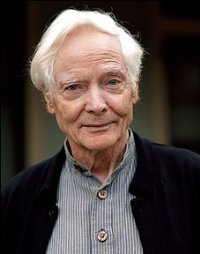
Because I do not have permission to reprint Mr. Merwin’s poem on my blog, I am encouraging you to buy his books by providing this link to them on Amazon. (buy now) Here is the short scoop on this wonderful poet. “Merwin was the 17th Poet Laureate Consultant in Poetry of the United States. He is the author of over fifty books of poetry, prose, and translations. He has earned every major literary prize, most recently the National Book Award for ‘Migration: New and Selected Poems’ and the 2009 Pulitzer Prize for Poetry for ‘The Shadow of Sirius.’ He lives in Hawaii where he raises endangered palm trees.”

I find Mr. Merwin’s photo to be almost as calming and comforting as this poem. I hope you enjoy them both.

Local National Poetry Month Events

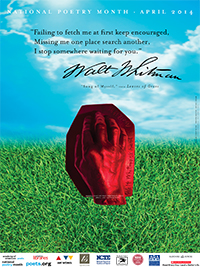
Cupertino Poet Laureate April Poetry Events

April 1 “Unsung Holidays: April Fool’s Day” Poetry Reading with Jennifer Swanton Brown and Guest poets: Stephanie Pressman & Amanda Williamsen, Peet’s Coffee & Tea, Stevens Creek Blvd, Cupertino 7-9 pm

April 4 Mary Avenue Dog Park Dedication, 5-6:30 pm

April 17 Art and Poetry: 5th Annual SJMA Poetry Invitational, San Jose Museum of Art “Initial Public Offering” poetry and art, 7 pm

April 19 Erica Goss & Friends Poetry Reading, Friends Bookstore, 110 East Main Street, Los Gatos, 2-4 pm

April 26/27 Cupertino Cherry Blossom Festival – Surprise poetry games and opportunities for the whole family! Memorial Park

Check out these local websites for all kinds of poetry month activities brought to you by my friends and colleagues.

Erica Goss: Los Gatos Poet Laureate
Starting with Book Launch Party for Vibrant Words: Ideas and Inspirations for Poets, Come and meet Erica and the members of PushPen Press for a reading and book-signing, CB Hannegan’s Restaurant, 208 Bachman Ave., Los Gatos CA 95030, Wednesday, April 2 at 6:00 pm

David Perez, Santa Clara County Poet Laureate
“National Poetry Month is upon us, and here are my upcoming events! Also, as many have requested, here is the video of the speech I gave at my reception. If you have questions, email me at info@thedavidperez.com. If you want reminders as events get closer, follow my Twitter @dperezer. Enjoy your poetry month!”

San Mateo County Poet Laureate Caroline Goodwin
Including Tuesday, April 22 – 9:00 a.m., Poetry Reading at the San Mateo County Board of Supervisors Meeting, Board Chambers, 400 County Center, Redwood City