Prompt # 24 Spring For Better or Worse

Last weekend was busy. On Saturday, March 22, I read my work with other local poets at the Saratoga Blossom Festival.  It was early in the morning, there was no parking, and I was tired from a week of teaching and hay fever. On Sunday, March 23, I was in Sacramento at the California Poetry Out Loud (POL) competitions. It was a great great event, and exhausting. Needless to say, I didn’t get prompt #24 past this point : the title of this post “Prompt #24 Spring for Better or Worse.”

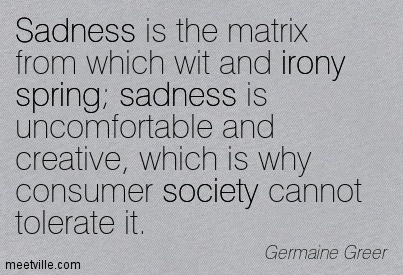
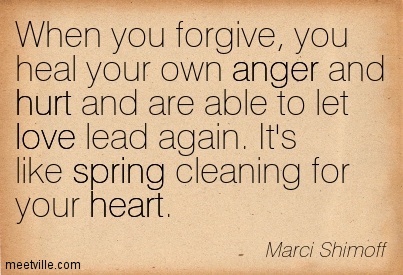
I’m not going backwards now, as this weekend is the time for Prompt #25, but I do want to let you in on my thought processes surrounding the “better or worse” title. While preparing the poems for Saturday’s reading, to be spring- or blossom-themed, I realized that a lot of my spring poems are pretty depressing. Part of being a poet is dealing with the sad and crummy emotions as well as the happy and glorious ones. The prompt, which I got as far as the title here and a shout-out on Facebook, was going to be to write about Spring from a non-traditional emotional place. Gloomy, reluctant, cranky, desperate, furious.

Quotation-Germaine-Greer-society-irony-sadness-spring-Meetville-Quotes-210674 Quotation-Marci-Shimoff-anger-heart-love-spring-hurt-Meetville-Quotes-124526

Anyway — in case you were watching, now you know. Stay tuned for reviews and photos of last weekend’s events and this weekend’s prompt.

I’m not sure why I feel compelled to keep the record straight, but there you have it.

Prompt #23 Green Birds

Happy (not Saturday) Monday! and Happy St. Patrick’s Day (if you’re Irish or otherwise celebrate the day) and Happy Green Birds of California Day (if you’re a slightly crazed poet…)!

I missed my chance to post my prompt on Saturday, and yesterday I spent the day outdoors in the sunshine and prepping for today’s poetry teaching start at a local elementary school. Now, three cups of tea later, I’m finally recovered enough think of a prompt and write a poem to go with it. Fortunately for me, one of my favorite blogs, Audublog, affiliated with Audubon California, has provided me with this fabulous post about green birds of California to get me (and all of us) started.

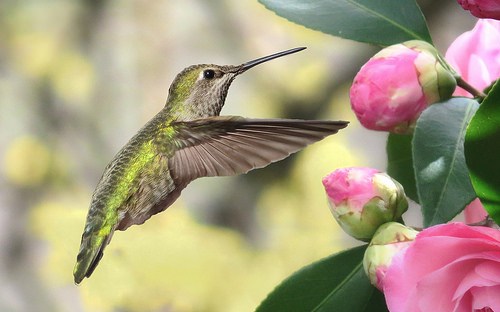
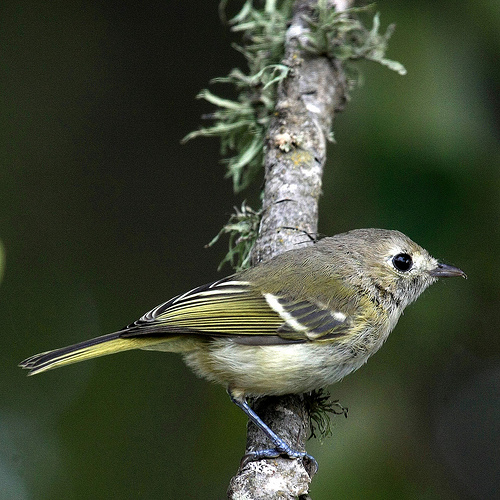
Let’s think of a poem today as something you can write that surprises you. Something you write in your own unique voice, without cliches. If you think of a green bird, you might visualize a bird you’re familiar with: a Mallard duck, an Anna’s hummingbird. And you could write a perfectly good poem about one of those. But what about the Violet-green swallow? Or the even less likely Ruby-crowned kinglet? Who names a green bird “ruby-crowned”?? I think my favorite green bird from this post is the Hutton’s vireo. I wonder who Hutton was? And why he named this sweet little fellow with the multicolored striped wings after himself?

Image

The tradition of writing poetry about birds is very Romantic (and yes, I mean that with a capital “R”). Here are a couple obvious choices:

One of my favorite bird poets writing today is Mary Oliver, who has written scads of  poems about egrets, owls, hummers.

Another favorite poet, Brenda Hillman, also writes about birds — they pop up in her strange and prickly poetry where least expected.

I couldn’t find any poems about the Hutton’s vireo, but I did find a great website that helps the birder differentiate one from a ruby-crowned kinglet — filled with great descriptions of their wings, head shape, and their songs. How is this for a delightful description of sounds that can’t be written down?

Voice is a much better character and is diagnostic once learned. The oft-heard, soft rattle of the kinglet is a dominant sound in wintering mixed flocks; it has been described as a scolding “je-dit, je-dit,” or “chiditdit” or a machine-gun “ah-a-a-a-a-a-a,” but it is not the least bit whinny. The vireo gives a typical vireo scold, a whinny descending “whee-we-we-we,” a nasal descending “cheee,” or may sing its two-part monotonous upslurred “zuwee” or “chew-wheet” song on warm days at any time of year (sometimes a downslurred “zeeoo…zeeoo….zeeoo.” In coastal California, serious singing by the vireo often begins in February when there are still a lot of kinglet around.

Your challenge for this week is to write a poem about a green bird. Investigate the Audublog, or look out your window and see what’s in your garden. Take a walk to a local pond and check out the ducks. Listen to the birds. Write down what they sound like. And then imagine that you can understand their songs — that would make a poem worthy of spring.

Prompt #22 Spring Flowers

It might be too early for many people around the Northern Hemisphere, but in California, Spring is here, full blown Spring, full of flowers and sunshine. It might seem a unforgivable cliche to suggest we write poems to Spring, but all cliches have their basis in true emotion, and nothing makes a heart swell with happiness more than the release of winter’s clutches into Spring. So let’s indulge ourselves.

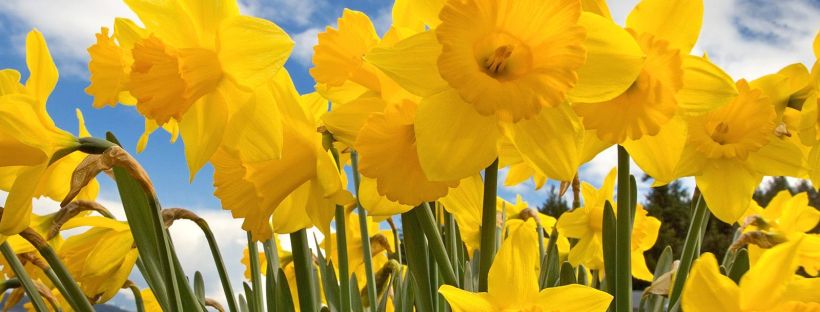
I Wandered Lonely as a Cloud” by William Wordsworth is the quintessential poem of Spring. Some people think this poem is called “Daffodils” but it has no true title, other than its first line. Especially for me, as I love daffodils, this poem has all the elements of romance, beauty, glad language, and even, in the last stanza, the note of loneliness and retreat so necessary to an artist’s live.  I offer it to you here entirely.

I Wandered Lonely as a Cloud

by William Wordsworth

I wandered lonely as a cloud
That floats on high o’er vales and hills,
When all at once I saw a crowd,
A host, of golden daffodils;
Beside the lake, beneath the trees,

Fluttering and dancing in the breeze.

Continuous as the stars that shine
And twinkle on the milky way,
They stretched in never-ending line
Along the margin of a bay:
Ten thousand saw I at a glance,

Tossing their heads in sprightly dance.

The waves beside them danced; but they
Out-did the sparkling waves in glee:
A poet could not but be gay,
In such a jocund company:
I gazed—and gazed—but little thought

What wealth the show to me had brought:

For oft, when on my couch I lie
In vacant or in pensive mood,
They flash upon that inward eye
Which is the bliss of solitude;
And then my heart with pleasure fills,

And dances with the daffodils.

Your prompt today is to write a poem to Spring. Let yourself go; indulge in happiness, in feelings of relief, pleasure, simplicity. If you feel like rhyming, go for it. We are so cynical in our modern complexity, so doubting in our rejection of beauty for beauty’s sake. Let yourself write a poem with butterflies or rainbows, with trees blossoming, with sunshine and promise.

If you want an extra challenge, spin the poem at the end inwardly — what is it that you fear about winter, about darkness that haunts you until Spring comes with the promise of a better day? What “vacant or pensive mood” is overcome for you when you think of a beautiful image, remember beautiful music?

Have fun with pure poetic pleasure today. And, don’t forget to turn your clocks ahead tonight, spring forward into the light!

Prompt #21 Your Heart

Now that February is over, we can discuss poetry about the heart without succumbing to Valentine’s Day. There is so much poetry about the heart – and it’s not all about love: romantic, unrequited, historic, young, fevered, or forgotten. I’m working on a lesson plan for a group of patients with cardiac disease, and this opportunity to think about the heart in its many guises is wonderful and intriguing. Just looking up “poetry + heart” on my favorite poetry websites has been an adventure. Here are a few things I found.

  • A Birthday” by Christina Rossetti (which might be one of my favorite poems of all time). Many of you have heard me recite at the drop of a hat, “My heart is like a singing bird.” Hear it sung here.
  • Finding the Space in the Heart” by Gary Snyder, which includes this breathtaking moment:
    O, ah!
    The
    awareness of emptiness
    brings forth a heart of compassion!
  • For years my heart inquired of me,” by Hafez, translated and with notes.
  • Heart” by Catherine Bowman, which worries about the heart in modern language of anguish, comparing it to an asp.
  • Sacred Heart” by Lee Briccetti, and speaks both of the valentine and about the heart’s physicality:
    “it was wet, like a leopard frog on a lily pad, / had long tube roots /”
  • Pericardium” by Joanna Klink, perhaps my favorite new find, which closes in this extraordinary way:
    “the way the body has always been waiting for the heart to sense / It is housed, it is needed, it will not be harmed.”

You get the picture. Many ways the heart has captivated artists, scientists and lovers throughout history. Many poems.

I’d like to encourage you to write about the heart. Try not to think about “love” per se, but of course, if it sneaks into your poem, that’s okay. Think about the heart as an engine – the miraculous things it does for your body. Think about your heart as an instrument – beating out the rhythm of your life. Think about the heart of someone else – how knowable is it? What about illnesses of the heart?

I’ll close with a sweet song I learned as a child, written (or at least recorded) by Shakespeare for The Merchant of Venice.  The little song is titled “Love” in some books, and suggests the beginning of love is the eyes, not the heart at all. There are many recordings and videos on YouTube, but this is the version I learned to sing as a teenager, though not quite like this.

TELL me where is Fancy bred,
Or in the heart or in the head?
How begot, how nourishèd?
Reply, reply.
It is engender’d in the eyes,
With gazing fed; and Fancy dies
In the cradle where it lies.
Let us all ring Fancy’s knell:
I’ll begin it,—Ding, dong, bell.
Ding, dong, bell.

The beautiful image at the top of the post is from the Spring 2014 issue of Stanford Medicine, a beautiful magazine.

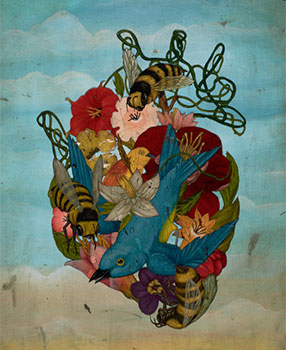
Finally, here is another illustration from that magazine. I encourage you to read about “The Mysteries of the Heart” and how this most sturdy and intricate organ is “yielding to research.”

heart birds

Prompt #20 Introduction to Poetry

Today I was fortunate to teach a poetry class to about 50 cardiovascular nurses, gathered at a local hospital for continuing education. Balancing self-care and caring for others is a continual pursuit for nurses. Because I’m a nurse as well as a poet, I appreciate the reciprocity between the disciplines of practicing art and caring for others. I wasn’t sure how the group would respond to the lesson I had prepared, essentially an expansion of a warm up I use with young students. But they were amazing. I shouldn’t have wasted a moment in worry. We laughed and cried. They wrote and shared. I felt very happy, humbled, exhilarated, blessed. And so grateful.

I started the lesson with this poem, “Introduction to Poetry,” by past U.S. Poet Laureate Billy Collins. I use this poem to reassure novice writers that poetry is not all about academic code-breaking. Analyzing great works of literature is all well and good, don’t get me wrong. I could do it all day long. But most people who want to explore poetry want to read a little, understand what they read, or, if they are mystified, they want that experience to be pleasurable. Even if reading poetry elicits emotions of grief, anger, compassion, the experience should essentially be one of inclusion and communion — not of confusion.

Anyone who is tempted to write poetry wants to feel confident that she has a place at the table. Your poetry can be whatever you want it to be — it’s completely possible to be a good amateur part-time poet. And Billy Collins’ poem suggests a few ways to approach a poem: like an object found in nature — a bee hive; or a fun experience — water skiing; or something beautiful to look at — a color slide of somewhere you traveled; or a game — a maze. Poetry is good. It shouldn’t put us off or frighten us. There are depths and complexities to great poetry, just like there are to great music (jazz or classical), to great art (Rembrandt or Pollack), to great wine. But who can afford to go to the opera or a museum every day, or drink the most expensive wine with every meal? Don’t you like to sing in the shower? Don’t you want a picnic with a cold beer once in a while? I hope more people will start with poems they like, reading alone or in groups, listening, and maybe some day take the plunge and write a little. You don’t have to be a prima ballerina to enjoy dancing at a wedding. You don’t have to understand John Ashbery to have a memorable experience writing a poem.

Your prompt for today is to look around you and find five objects in your every day life — one that you can appreciate with each of your senses. Did you notice how Billy Collins engages a poem with his eyes, his ears, the feeling of water splashing against his skin, the touch of a sensitive nose? Then, simply, write “poetry is…..” with each of those objects. We are used to talking about a beautiful dancer or figure skater as poetry in motion. We are used to calling a rich chocolate dessert poetry on the plate; the master chef can be called a poet in the kitchen. See if you can do it. Let yourself notice that there is poetry all around you at home, at work, in town, on a hike, with your family, in your dreams. Maybe a little mystery will find its way into your poem. Let it in. Maybe a little rhyme or repetition will emerge. That’s fine. Feel the poem in your body, say it out loud, what does that suggest for the poem?

Here’s my example:

Poetry is the rhythmic licking of the cat washing her face. Her spotted paw polishing her pink nose.
Poetry is the dog, in the February sunshine, turning around turning around turning around.
Poetry undulates with the clean sheets, my husband helps me make the bed.
Poetry settles on the windows as darkness settles on Saturday.
Poetry is the clattering fork whisking eggs in a bowl, the smell of my son making his supper, his little hums and yummy murmurs.
Poetry is strong fingers on the keys, typing typing typing, thinking about my mother with every word.
Poetry, a weekend family feeling.

Embellish Your Poetry with the Web

This poem, the genesis of which I described in an earlier post, is an example of how to embellish your poetry with “junk and stuff” you can easily find on the internet. Hyperlinks are easy, and while they might take your reader away from your poem temporarily, they might also provide context or audience to a poem that might enjoy a little of both.

Ode to an Oddball Winter

A giant runaway snowball
crashed into a college dorm.
Nothing about this winter
fits the norm.

Floodwaters rise in England
taking lives and homes –
Eliot’s strong brown god
groans.

Drought in California!
Farmers and ranchers fear,
gardeners, fishermen, skiers
stow their gear.

Brutal ice in Georgia
cancels Valentine’s Day.
Power’s out, trees are lost,
skies are gray.

Winter comes to all;
none are spared its pain.
Some will find its beauty
and love again.

Darkness threatens the spirit,
but shivering warms the blood.
Daily the light shines longer on
first bud.

Let’s write a poem for pleasure,
tell a story to coax a smile,
sing a song to offer solace,
survive in style.

If you’re writing a poem to enter in the Cupertino Library’s Silicon Valley Reads Poetry Contest, this is one way to get your poem to speak both on the page and in the techno-sphere.

Another place to explore, if you want ideas for how to combine poetry and other media, I suggest you visit The Poetry Storehouse. They have a host of videos that use poetry and I encourage browsing there. A “remix” I did of Erica Goss’s poem “Afternoon in the Shape of a Pear” is another type of poem + technology fun. I am still drawn more to collage than to video, but the field is wide open. Go for it!

Prompt # 19 Ode For An Odball Winter

Hello poetry friends! Today’s prompt will serve double duty: I want to tempt you to write in one of my favorite forms, the ode, but also I want to create a sample poem on one of the themes for the Silicon Valley Reads Poetry Contest, sponsored by the Cupertino Library. Here goes!

An ode is one of the oldest poetic forms in Western culture. As my friends at the Academy of American Poets describe:

“‘Ode’ comes from the Greek aeidein, meaning to sing or chant, and belongs to the long and varied tradition of lyric poetry. Originally accompanied by music and dance, and later reserved by the Romantic poets to convey their strongest sentiments, the ode can be generalized as a formal address to an event, a person, or a thing not present.”
I love to teach odes, because kids get the idea quickly. We talk about Beethoven’s “Ode to Joy” which many of them have learned to play on their recorders if they are lucky enough to have music in school, and they readily understand praising and celebrating something or somebody. Read a couple of student odes at the CPitS website, in the Youth Poetry section.
Pablo Neruda, one of my favorite poets, wrote many odes (collected in translation and the original Spanish) in Odes to Common Things, common things like onions and chairs. He’s great to teach, too, especially if you have kids in class whose first language is Spanish. Neruda’s odes help dispel the silly idea some of us picked up in English Lit class that odes have to be about urns and dead athletes and other things we don’t care much about anymore. This one, “Ode to a Large Tuna in the Market” will give you a flavor.
pabloneruda
Today I wrote an ode to the oddball winter that is 2013-2014. The idea started when I read a news story about kids at Reed College who crashed a huge snowball (800 lbs) into a dorm wall, damaging it and setting of a viral news story. I didn’t really mean to write a poem with rhyming metered stanzas, but it happened, so I went with it.  (Use a web-based site like RhymeZone if you don’t have a rhyming dictionary.)
My poem (which I’ll publish in a separate post) is also an example of how you can hyperlink images, music, and other information to your poem, if you want to experiment. One of the prompts for the Silicon Valley Reads poetry contest is to “write a poem using technology as part of the process. Use hyperlinks, video, photos or music as part of the poem’s form.” This poem of mine, “Ode to An Oddball Winter” is just such a conglomerate mishmash kind of poem.
Enjoy!

Prompt # 18 “Men kill for this” Remembering Maxine Kumin

What a week. Maxine Kumin, a great poet and powerful foremother, died at 88. Iranian poet and activist Hashem Shaabani was executed for his writings. Actor Philip Seymour Hoffman succumbed to his addiction with a lonely needle gesture. I attended a beautiful and moving reading by Louise Glück, who read new poems about the imagined end of a creative life; her reading left me bereft in a way I did not expect. Maybe it’s the rain, which we thirsty Californians revel in, but which greets me in the morning with a darker sky. In any case, I am writing sad stunted miserable poems this week, or, fighting the urge to.

Reading back through Kumin’s poetry, I found a lovely poem that I feel brave enough to offer as a prompt. “Appetite” is a short lyric, less technical than some of Kumin’s work, but still shaped with formal restraint. You can hear Garrison Keillor read it in this 2002 recording of his Writer’s Almanac. Even better, you can hear Kumin read it herself (as part of a delightful lecture/reading) in the (Emily) Dickinson Electronic Archives. She calls it “a little father poem.”  Because it’s reproduced all over the internet, I’ll risk posting it here, without permission.

Appetite

I eat these
wild red raspberries
still warm from the sun
and smelling faintly of jewelweed
in memory of my father

tucking the napkin
under his chin and bending
over an ironstone bowl
of the bright drupelets
awash in cream

my father
with the sigh of a man
who has seen all and been redeemed
said time after time
as he lifted his spoon

men kill for this.

Isn’t it funny how eating reminds us of our family in such powerful ways? I remember my father sitting down at the dinner table every single night to whatever meal my mother put in front of him, lifting his fork and saying, without fail, “This is the best dinner I have ever had.”  That generosity, that gratitude epitomized my father and defines him still for me, if now only in memory.

Your challenge today, your opportunity, is to write about eating with your father. And if that’s a relationship you don’t want to remember or imagine, then pick someone else you ate with regularly, someone whose habits at the dinner table, the picnic table, the lunch counter, the brunch buffet, the bar, are part of your permanent history.

If you can make a connection in your poem between eating and death, I’ll give you extra credit.

Enjoy Maxine Kumin’s poem and think about your delicious short life.

Prompt #17: Surrealistic Football

So much to write about this weekend: Chinese New Year, February and how it brings spring to California, and today, rain! But I was supposed to write this prompt yesterday and was planning to write about football, so I will stick to my plan. More people (in the US) will be interested in the Super Bowl today than in the rain, although I’m wiling to guess that most Cupertinians are thinking about the rain first and foremost. And almost nobody is thinking about poetry, but that’s nothing I can change. Except maybe with today’s poem. (From the Poetry 180 website, “A poem a day for American high schools.”)

This is my favorite football poem of all time, aptly titled “Football” by Louis Jenkins; it’s fun to read and to teach. It’s written in a prose poem form, which may seem “just wrong” to many poetry traditionalists, but which is, in fact, not “new” or “modern” and has been accepted as a true form by many literati.

My favorite things about this poem are its conversational tone — the way the speaker of the poem invites us into the experience and then asks us to share his surprise — and the surrealistic quality of the imagery. Most kids love that freaky question: how indeed could a football transform into a shoe? I’ve taught it together with Salvidor Dali paintings and sculptures  — the images of his lobster phone and melting clocks always delight younger children and seem aptly bizarre to teens.

ImageImage

But kids also respond to the speaker’s outrage, and they instinctively understand the fraud perpetrated on all of us by corn syrup masquerading as maple. (This is usually where I divert the lesson into a discussion of faux vs. true and what types of things accept in our lives because we can’t have/don’t want/aren’t allowed to have the originals.)

The end of the poem is a point of personal decision, where humor and  seriousness converge: “One has certain responsibilities, one has to make choices. This isn’t right and I’m not going to throw it.” I especially love how the word “throw” conveys both the physical act of hurling a ball down field, but also means to purposefully cheat — “throwing the game” to let the other team win.

And this is where today’s prompt comes in. Take several minutes to think about these questions and to write down your thoughts:

  • What choices do you face, both serious and lighthearted, where if you cheat, you might win?
  • What objects can you think of where the substitute is generally accepted but not really welcomed? (fur coats, fat-free potato chips, faux leather jackets, boots, purses?) What is better or worse about the substitute?
  • What objects are related to each other in a way that you wouldn’t expect? A football is like a shoe, as a guitar is like a cigar box, as a book is like a cereal box. What is the one thing they have in common; what are the important ways they differ?

See if a poem arises from one or more of these musings. And, if all that is too strange, difficult, or just weird, then write a poem about football — about the tastes, smells, sounds, as well as the visuals associated with this violent secular national holiday, Super Bowl Sunday.

Prompt #16 : Year of the Horse

Chinese New Year is here. Everywhere I go in Cupertino I can see the signs. The nail shop had a lovely tree with yellow flowers and red & gold paper money envelopes hanging all over it. There were gorgeous yellow chrysanthemums* in pots decorated with red and gold bows. My realtor sent us a shiny gold envelope, decorated with red Chinese calligraphy, containing a crisp single dollar bill. She wishes us Gung Hay Fat Choy!

chinese-new-year-2014_1389998588

There are many many people in Cupertino who can tell you more about this holiday than I can; I’m not an expert, not even a little bit knowledgeable. I know that I was born in the year of the rat, and furthermore that I’m a metal rat (1960).  Anyone born this year will be born in the year of the wood horse (2014). I’m not a great believer in astrology, but I love symbol and image, I love tradition and color and storytelling and celebrations. So, to celebrate Chinese New Year, I’m going to write a poem to a horse.

There are many poems in English about horses.

  • This one, “Horse Horse Hyphen Hyphen” by Marilyn Chin (a Chinese American poet from Hong Kong and Portland OR), speaks wildly about Chinese zodiac, custom, sex, disappointment and family.
  • There is an entire genre of “horse haiku” written by horseback riding enthusiasts — most of it not great haiku and not remotely Japanese.
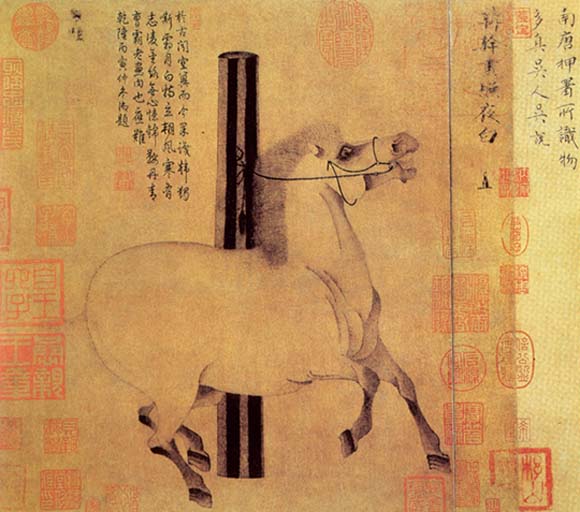
  • This 2008 essay “Horses and Poetry” discusses poetry about horses and includes a lovely Chinese painting with poem from the Tang Dynasty. chinese horse poem
  • This site presents wonderful translations of multiple Chinese poets into English by the great and wonderful Kenneth Rexroth. I particularly like “Jade Flower Palace” by Tu Fu, which includes this image:

Only
A stone horse is left of his
Glory.

So, your challenge this month is to write a poem about a horse, or if you’re feeling energetic, to look up your Chinese zodiac sign and write about that. Have fun. And I wish you health, happiness, success and good fortune in the new year.

*The chrysanthemum is one of the “Four Gentlemen” (四君子) of China (the others being the plum blossom, the orchid, and bamboo). The chrysanthemum is said to have been favored by Tao Qian, an influential Chinese poet, and is symbolic of nobility. It is also one of the four symbolic seasonal flowers. (Quoted from Wikipedia. Please comment if you know more about this, or if it is incorrect.)