Discovery Day 2105

I love Discovery Day. Other schools call it Career Day, or the like, but at Regnart Elementary School in Cupertino, they call it Discovery Day. I first started talking to Regnart students about my life as a poet when my own kids were there. This past month, I had the special privilege of not only talking about being a poet and a poetry teacher, but of explaining what a poet laureate is.
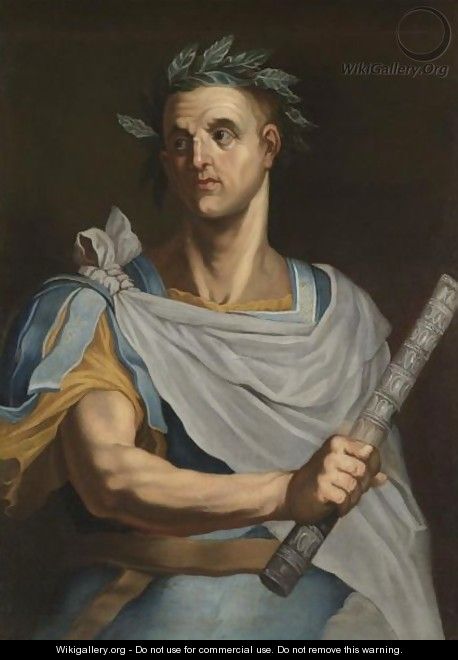
julius ceasar with laurel wreath

roman with wreathe

Fortunately, third and fourth graders usually have been introduced to images of Greeks and Romans in togas, with laurel wreathes on their heads. That helps them understand that a laureate is a person recognized for her wisdom or status in a particular field.

al young with laurel wreathe

Former California Poet Laureate, Al Young, with his laurel wreath.

Of course, I explain, I’m not really not the most famous or wisest poet around, and the PL status I enjoy is only loaned to me by the city. But they understand that it’s my job to teach about poetry in Cupertino, and several of them remembered seeing me with my magnetic poetry at the Library Anniversary last October.

This year I had a great time, as always, and I talked to the kids about how the Chamber of Commerce had asked me to write a poem for the Lunar New Year. Many kids recalled that we just celebrated the Year of the Ram, Goat, or Sheep, and in each class there was a child who spoke the one word in Chinese that could be translated into any one of these animal words in English. I shared with them my Lunar New Year sestina.

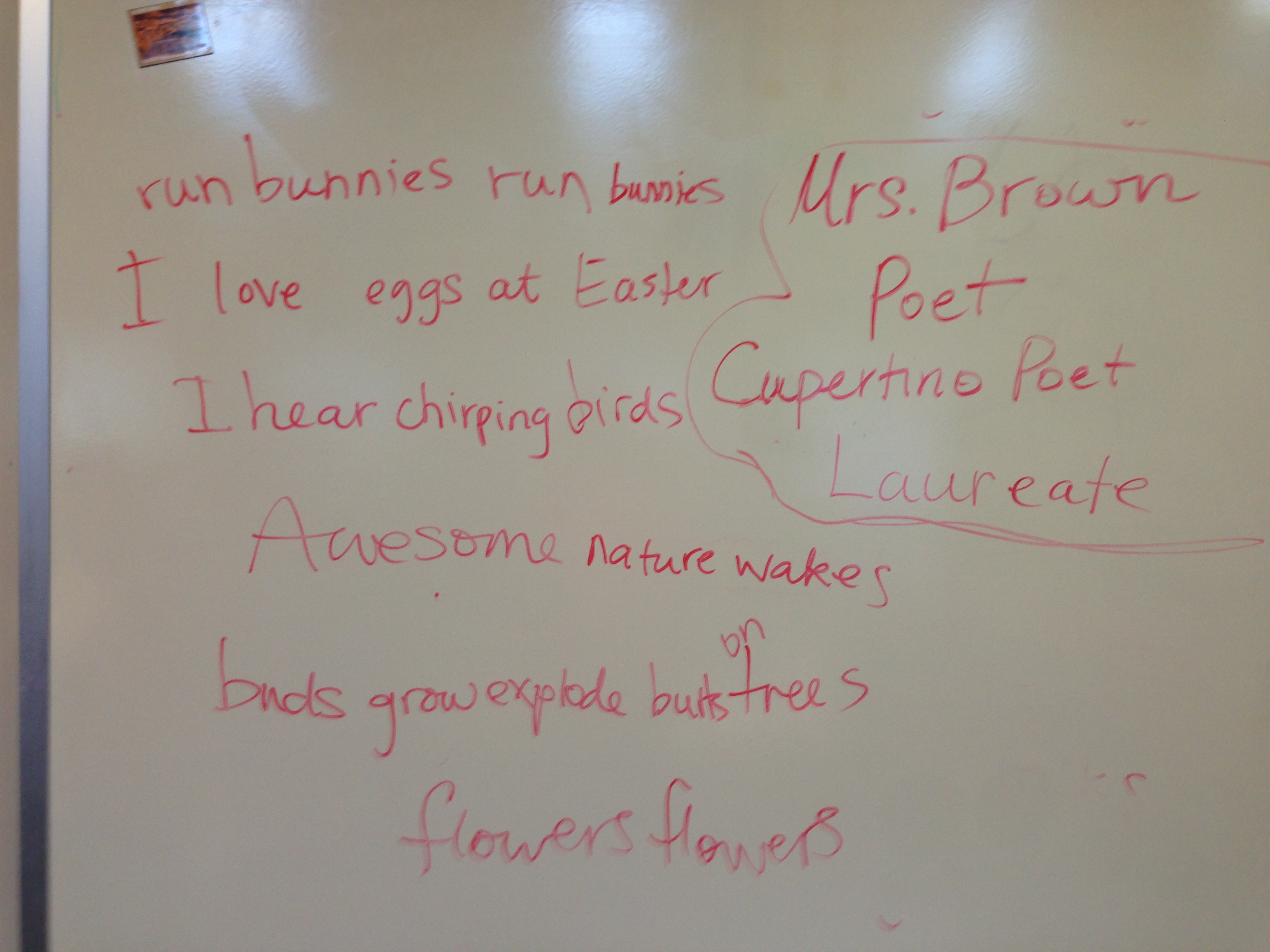
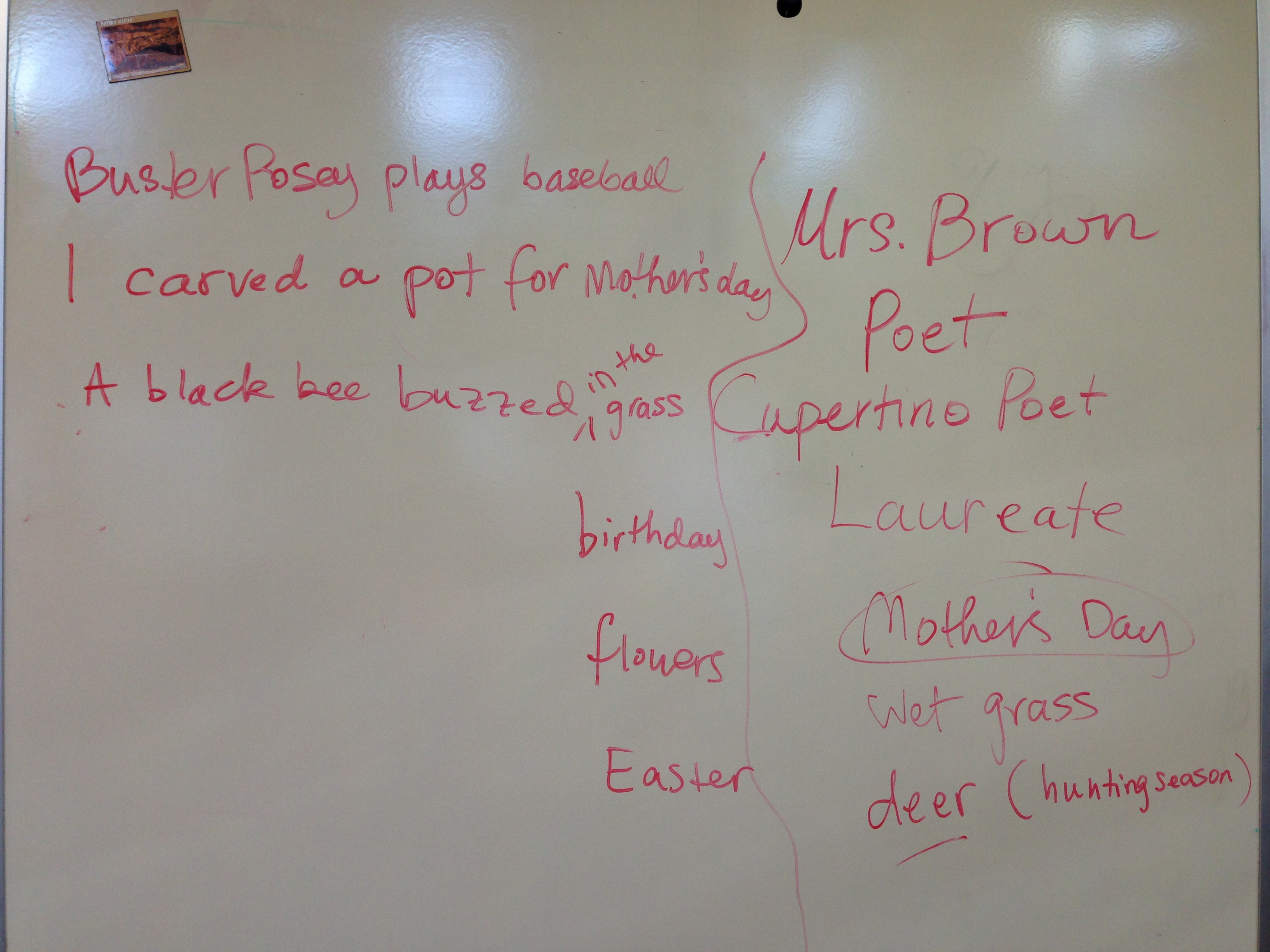
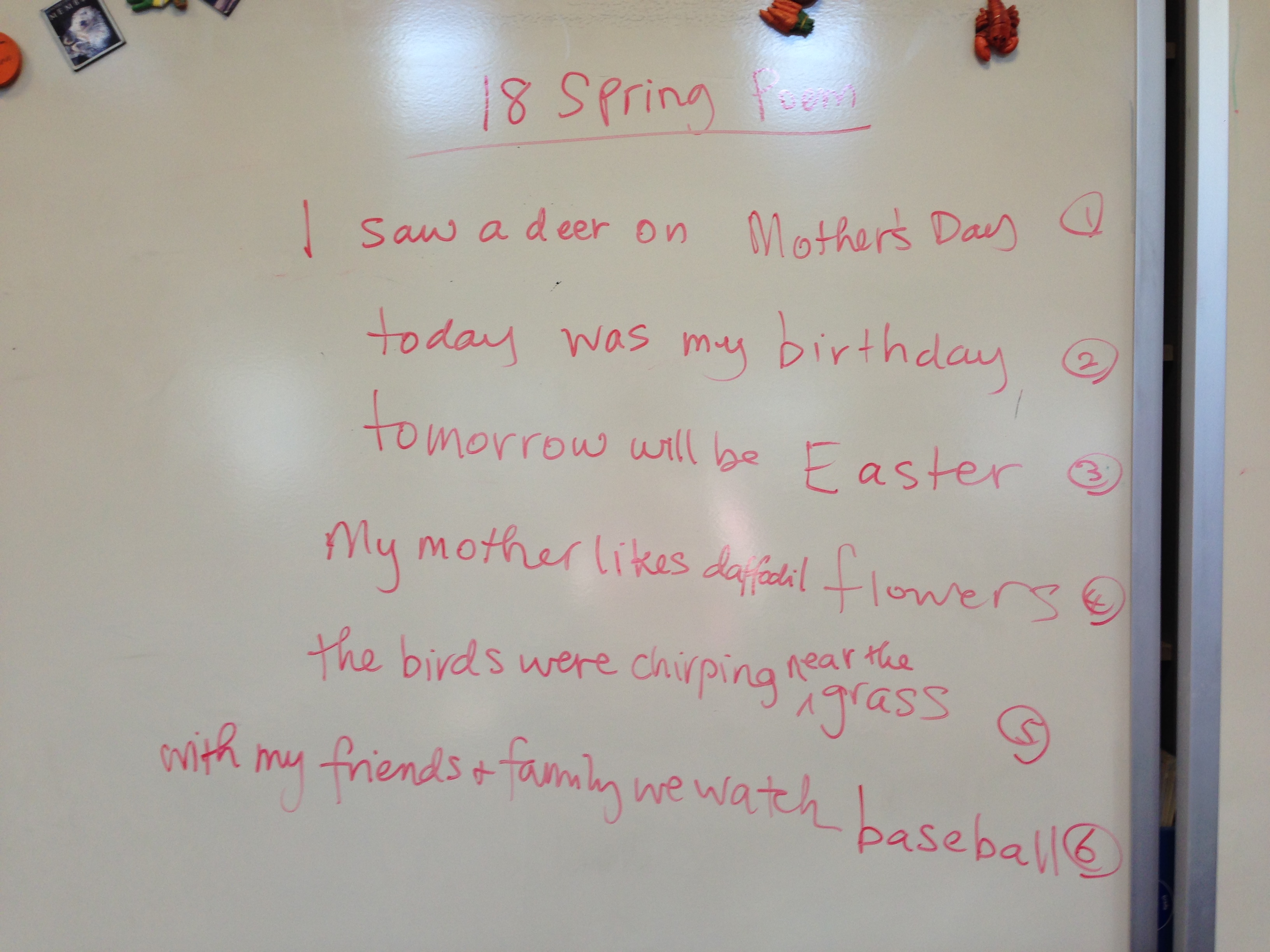
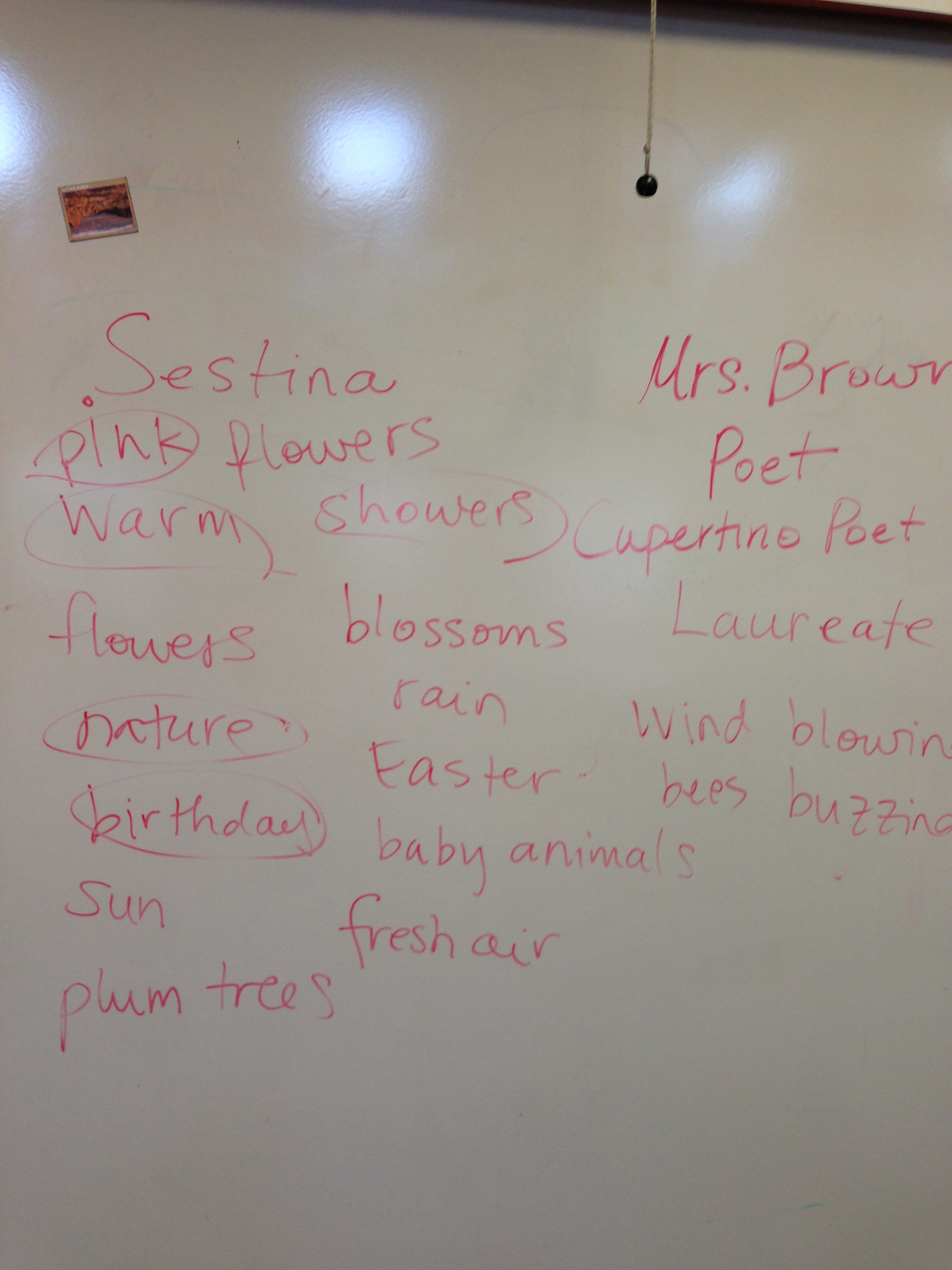
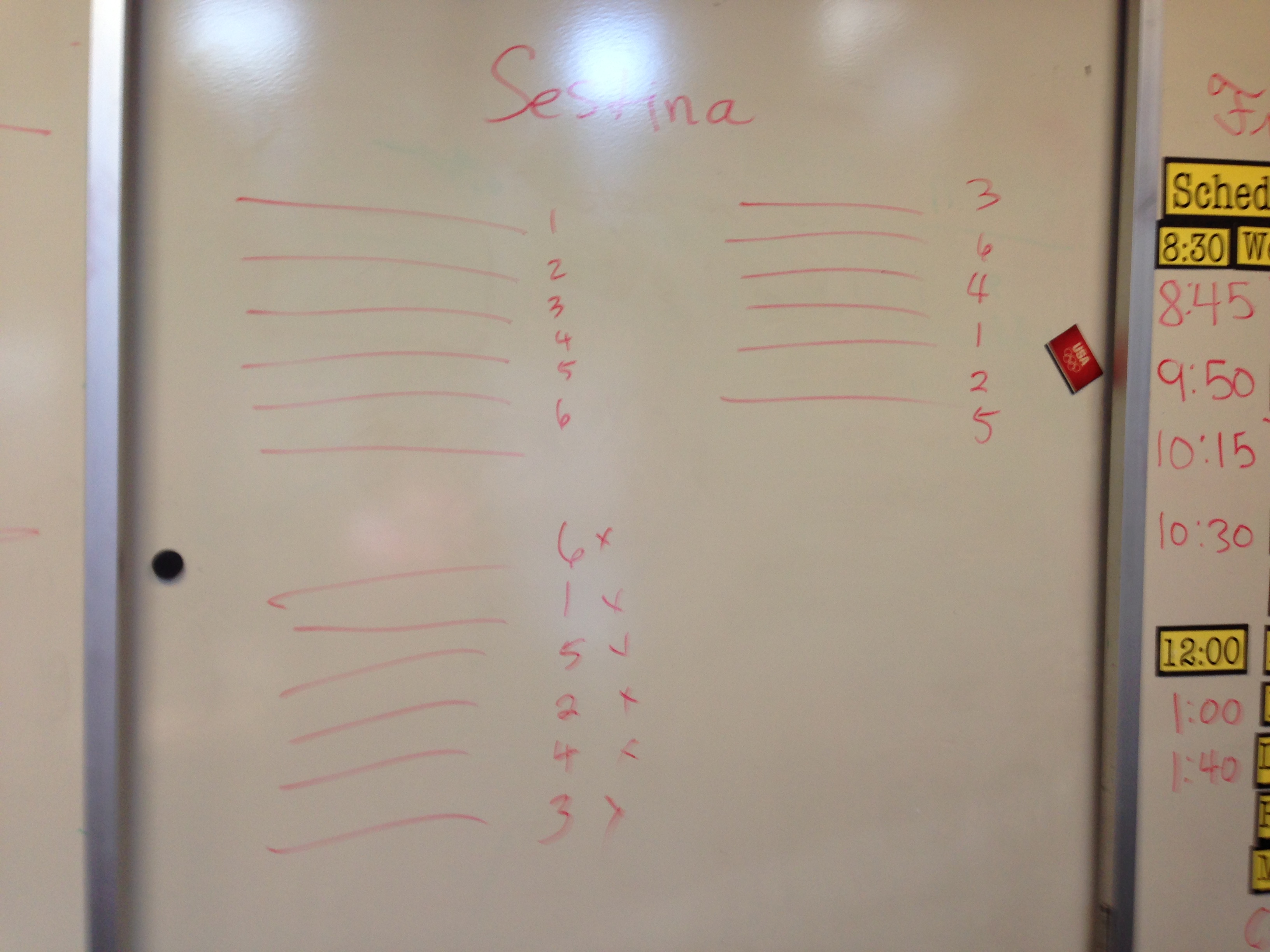
Then I explained that I wanted to write a sestina with them about spring. We discussed how many kids had celebrated Holi, how many celebrate Easter. The kids knew all about St. Patrick’s Day, President Lincoln’s birthday, and April Fools Day. Some remembered Pi Day. We talked about baby animals, the flowers and trees and the smells and the warm air.  I pushed them to remember details from their own houses and gardens and not just “greeting card” images and ideas.
Discovery Day 3

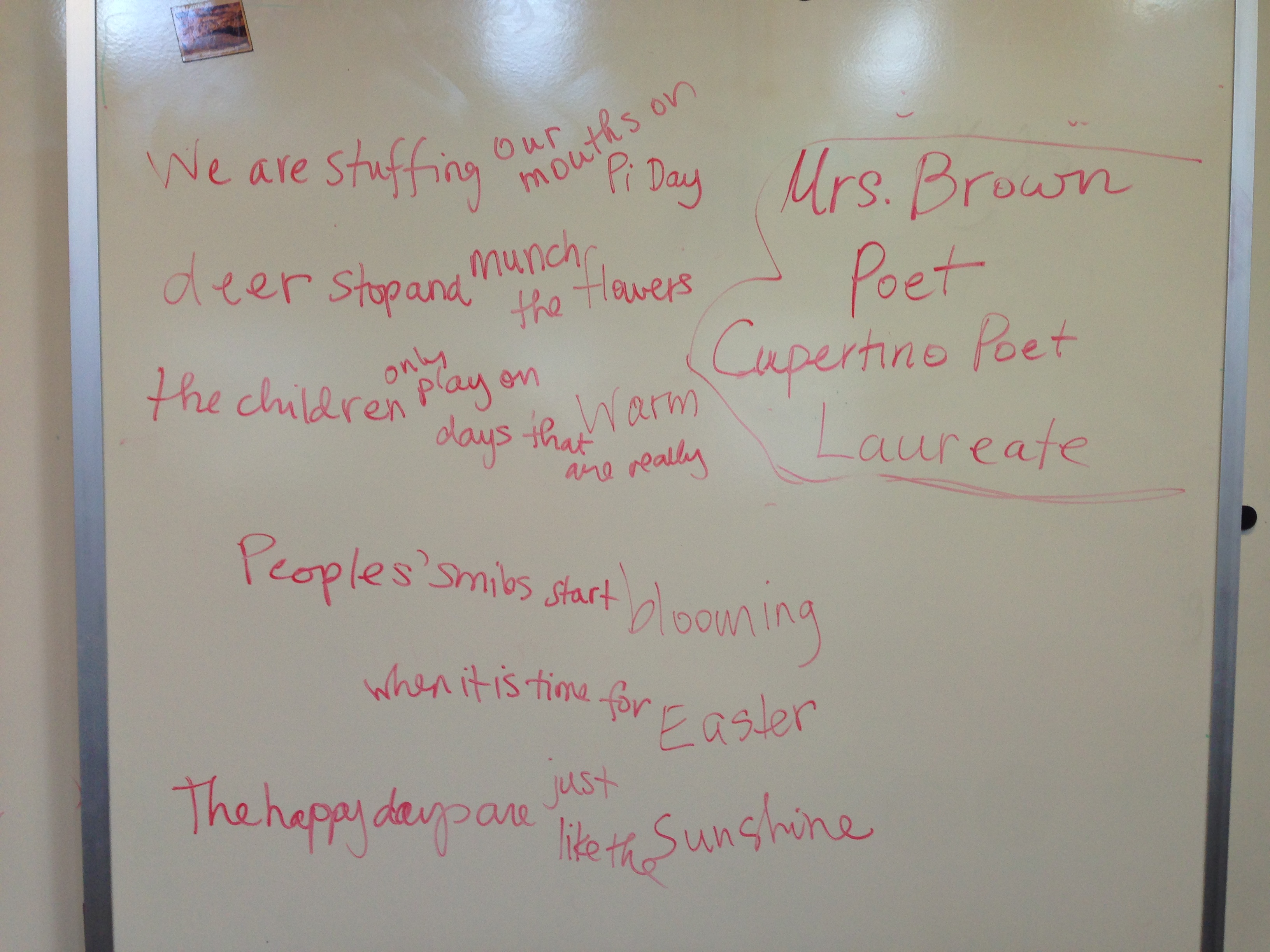
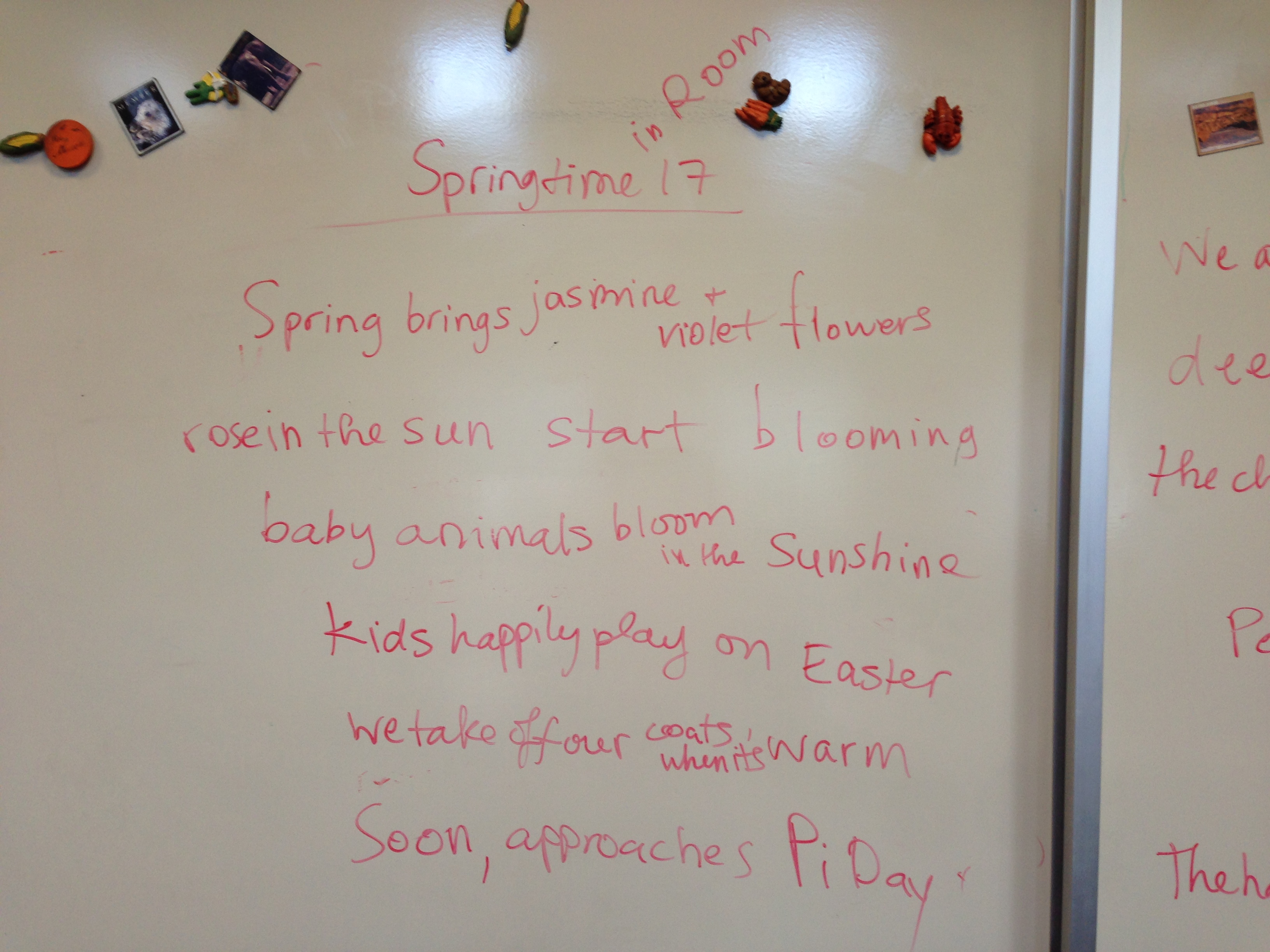
In each class we wrote at least one stanza of a sestina. Here are some photos I took from the whiteboards. I hope to get some of these poems typed up and shared back with the students. I think at least one teacher was going to encourage the students to write the rest of the long sestina poem. Wouldn’t that be grand?
Discovery Day 1 Discovery Day 2  Discovery Day 4 Discovery Day 5 Discovery Day 7 Discovery Day 8 Discovery Day 9

I hope they ask me again next year.
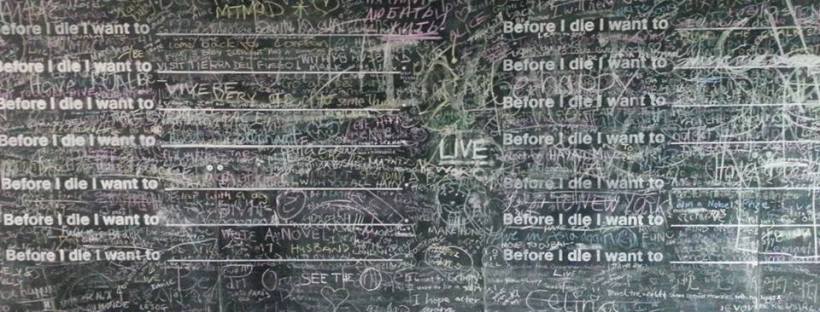
Before I Die I Want To . . .

Have you ever thought of writing your New Years resolutions, wishes, dreams, plans, goals — as a poem? I’m going to try to get mine into rhyme. Wouldn’t that be fun. To live life in rhyme.

Before I die I want to sing
Before I die I want to walk
Before I die I want to blink
Before I die I want to wing

Here’s a list of New Year’s Poems from the Poetry Foundation. I snagged this photo from their site, too, (by Derek Keats).

nyfirework

If you click through to read Robert Haas’ “After the Gentle Poet Kobayashi Issa” you will encounter this haiku.

New Year’s morning—
everything is in blossom!
   I feel about average.
I think this will be my New Year’s resolution, goal. To feel about average every day. On days when I feel good, I’ll be slightly ahead, and on days when I don’t, I won’t be too disappointed. And if you’re not worried about how you’re feeling, you can enjoy the view of everything in blossom. Everything.
Happy New Year poetry people.

Poetry About Race

If you’ve been following me on Facebook, you might have seen my posts about New York Times op-ed writer, Nicholas Kristof, and his call for poems about race.

Here are two articles that he’s written in response to the 300+ poems he received. The commentary is interesting, but the poems are wonderful. Angry, beautiful, hopeful, terrifying.

I don’t want to quote from the poems here, I want you to go and read them all. Then I think we should all get together and write our own. Soon.

A Very Great Poet is Gone: Galway Kinnell

A great American poet is gone. Galway Kinnell, whom I met several times, both at Poetry Center San Jose in the 1980s and at the Squaw Valley Community of Writers, where he was lauded as one of the founders, has died. You can read many of his poems at the Poetry Foundation site, and there are numerous videos of him reading his work, as he came to prominence in the age when people first thought to film poets.

Here is a short collection of some, I particularly love.

One of my very favorite poems of his is “St. Francis and the Sow” which you can read here. Reading this poem as a young woman encouraged me, gave me a place to start. These two lines are among the reasons I teach poetry:

though sometimes it is necessary
to reteach a thing its loveliness

reading_000

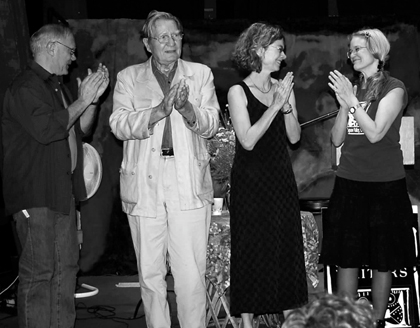
This photo is from the SVCW’s website. That’s Bob Hass, Galway Kinnell, Brenda Hillman and Sharon Olds, probably at a benefit reading.

Poetry and Film. A Review of the Zebra Poetry Film Festival.

Thinking more and more about my International Poetry Project for 2015. Click through here for some lovely poetry films.

Jennifer Swanton Brown's avatarJennifer Swanton Brown - A Twirly Life

My friend Erica Gosswrites here about the Zebra Poetry Film Festival she attended in Berlin. With eleven poetry films curated with her comments. If you do nothing else today, make sure to click through and view the winning film, “The Dice Player” by a young Egyptian filmmaker Nissmah Roshdy, based on a poem by Israeli Palestinian poet Mahmoud Darwish.

dice player

Lovely, moving, startling, accessible, powerful. Poetry.

View original post

A Code Poet Connection

I’ve been searching for references to Eavan Boland’s poem “Code” as research for an upcoming project, and I ran across a fellow poet who likes math as a stimulus for poetry. JoAnne Growney’s blog, Intersections — Poetry With Mathematics — is full of very cool stuff. She’s got math, she’s got computer code, she’s got international politics and frogs. Check it out!

The poem I was searching for, “Code,” is posted and discussed here on Growney’s blog. You can read more of Boland’s poems and biographical information at the Poetry Foundation.

eavan boland

Eavan Boland

This poem, published in the US in 2001 in a book titled Against Love Poetry, was published in the UK first, where the collection was titled Code. This article from the New York Times review of the book, explains how Boland:

“adds another dimension to her literary persona, showing herself to be a poet not only of feminism and Ireland, but one interested in making sense of the way the abstractions of time and space play themselves out in human relations.

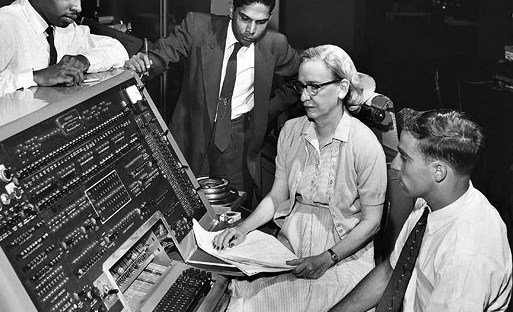
The most succinct, lingering expression of this interest comes in a poem called ”Code,” an ode to ”Grace Murray Hopper 1906-88, maker of a computer compiler and verifier of COBOL.” In it, Boland envisions Hopper writing code at her desk in New Hampshire and tries to connect with her over distance and generations: ”You are west of me and in the past,” she writes. In these few simple words, Boland transforms the past from a place that is long gone to a place that we can travel into, just as in any other direction; then she goes there with great effect.”

Are you interested in code poetry or poetry about math? Stay tuned!

(Photo of Eavan Boland from an unattributed website. Photo of Grace Murray Hopper from Wikipedia, cited from the Smithsonian.)

On the Feeble Attempt to Teach Beauty By Heather Altfeld

A must read. A lovely article. Poetry, teaching, beauty, children, yes.

On the Feeble Attempt to Teach Beauty By Heather Altfeld.

The Running of the Poets

Yes, I’ll be reading with this great group on June 14. Come to San Mateo County to hear us!

San Mateo County Poet Laureate's avatarsmcpoetlaureate

In October, when I received the good news that the selection committee wanted me to serve my community as Poet Laureate, my friend Hugh Behm-Steinberg was delighted for me. “Have fun,” he said. “Do something really fun, like the Running of the Poets!” I got to thinking, and talking to people about the idea, and someone suggested the County Fair as a venue. Perfect. And so… Behold.

There will be two events: one on 6/7 at 3:00 pm and another on 6/14 at 6:00 pm. I like to keep Borges in mind again: Poetry always remembers that it was an oral art before it was a written art. It remembers that it was first song.

So come on down and hear Terry Adams, Maisha Johnson, Dorsetta Hale, Hugh Behm-Steinberg, Erica Goss and Sarah Kobrinsky on 6/7 at 3:00 pm

And Keith Ekiss, Robin Ekiss,Maurine…

View original post 26 more words

Poem In Your Pocket Day with Love from Emily

Enjoy poems in your pockets or in your life today. You can watch videos and print poems for your pocket at the Academy of American Poets website.

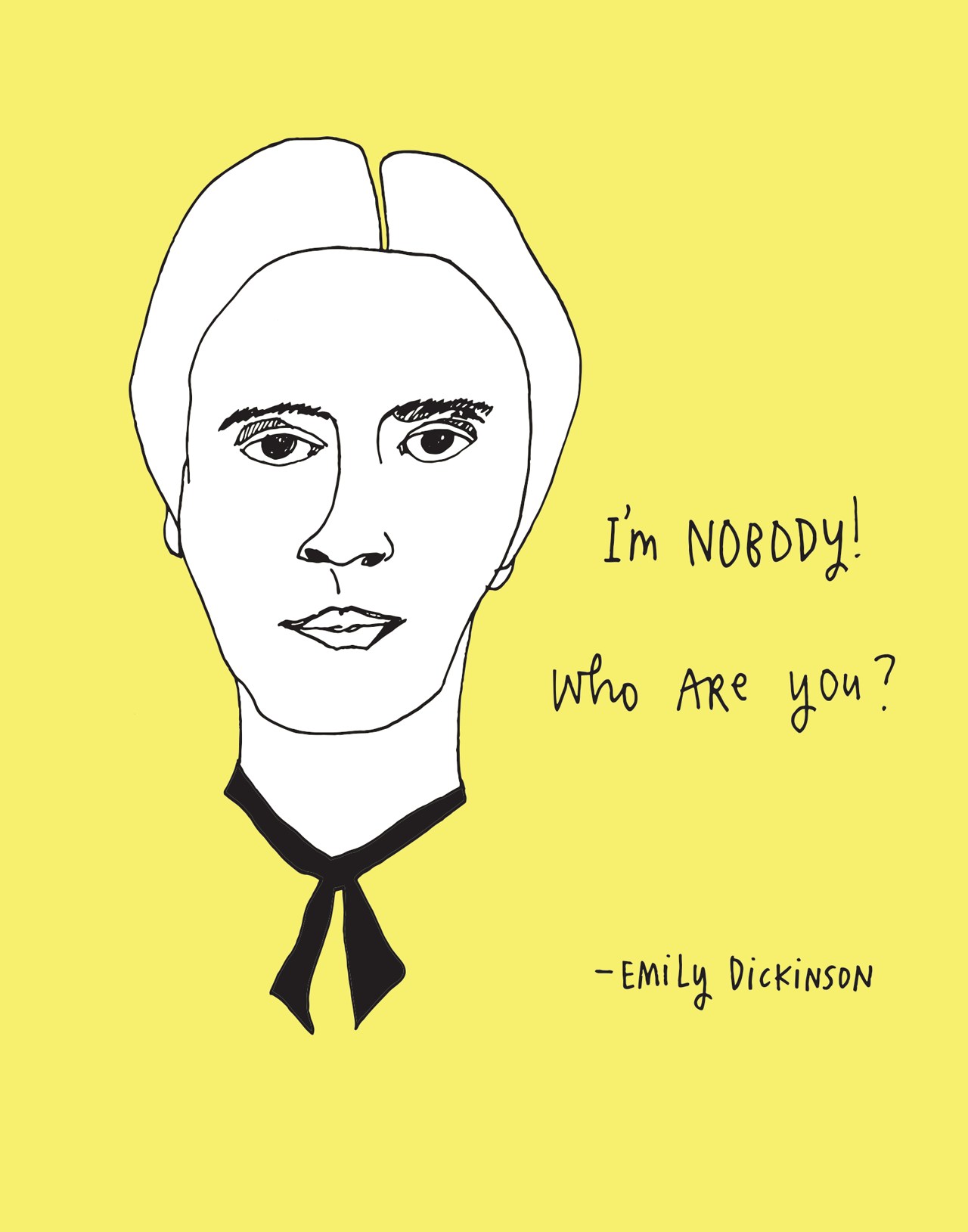
My favorite poem (in my pocket right now) is Emily Dickinson’s famous “I’m Nobody”

I’m Nobody! Who Are you?

I’m Nobody! Who are you?
Are you – Nobody – too?
Then there’s a pair of us?
Don’t tell! they’d advertise – you know!

How dreary – to be – Somebody!
How public – like a Frog –
To tell one’s name – the livelong June –
To an admiring Bog!

Emily Dickinson

EMILY-DICKINSON-IM-NOBODY

Illustration by absolutely awesome artist, Susa Talan. See more of her work here.


Code Poetry 1:1 at Stanford

Code Poetry 1:1 at Stanford

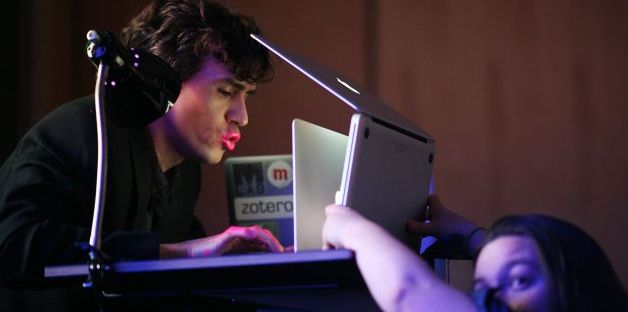
Stanford had another Code Poetry event, and I went this time. It was quite astonishing. Poets from all around the world, some in the room, and some participating via Google Hang Out. Surrogate performers for poets who couldn’t be present. Pink lipstick that glowed in the dark (you’ll have to read the article to figure out that one…).

I’m hoping to work together with Melissa Kagen, the Stanford student who is getting grants to put on these events, to sponsor one right here in Cupertino. Watch this space!