Dog Park Rules

To honor the opening of Cupertino’s Mary Avenue Dog Park, I’ve written a little villanelle. They’ve posted the poem at their website, but I offer it here, too. I read this on Tuesday at my April Fool’s Day reading, and it seemed to appeal to the people there. I hope dogs like it too.

Especially for my dog-loving friends, Michelle, Cristina, and Alice.

Dog Park Rules (A Villanelle)

Watch out for balls and feel the winter sun.
Remember who you came with, when you came.
Run and run and don’t forget to run.

The most important rule is to have fun.
Smell all the smells, then smell them all again.
Watch out for balls and feel the spring-time sun.

Spin your body, spin and when you’ve spun
yourself into a puddle, change the game.
Run and run and don’t forget to run.

Sniff the spots that human noses shun.
Pee and pee and all good places claim.
Watch out for balls and feel the autumn sun.

Stay with that stick until the chewing’s done.
Leap and wiggle your small body like a flame.
Run and run and don’t forget to run.

And now the Dog Park rules are almost done,
and you will learn them as you learned your name.
Watch out for balls and feel the summer sun.
Run and run and don’t forget to run.

For more dog poems, check out Mary Oliver and Billy Collins, fans of dogs and fine poets.

Those of you interested in more information about villanelles, check this out and this.
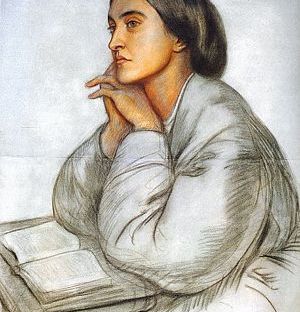
Christina Rossetti “A Birthday”

For the second day of National Poetry Month, I offer one of my all time favorite poems, “A Birthday” by English poet, Christina Rossetti.

A Birthday
By Christina Rossetti

My heart is like a singing bird
Whose nest is in a water’d shoot;
My heart is like an apple-tree
Whose boughs are bent with thickset fruit;
My heart is like a rainbow shell
That paddles in a halcyon sea;
My heart is gladder than all these
Because my love is come to me.

Raise me a dais of silk and down;
Hang it with vair and purple dyes;
Carve it in doves and pomegranates,
And peacocks with a hundred eyes;
Work it in gold and silver grapes,
In leaves and silver fleurs-de-lys;
Because the birthday of my life
Is come, my love is come to me.

I often teach with this poem, because I know it by heart and love to look at the faces of young students when I’m reciting it for them. Nothing commands their attention better than a poem read from memory, a true performance. There are also so many visual images, and some strange and bizarre words that make us laugh (click through “vair” to see what I mean, poor Sciurus vulgaris).  The poem lends itself to fruitful discussions of simile and metaphor, and is a convenient opening for a lesson about how our bodies have feelings that our minds sometimes are afraid to articulate.

Drop me a comment about this poem, or share one of your own.

314px-Geoffrey_of_Anjou_Monument with vair lined mantle

Enamel effigy of Geoffrey Plantagenet, Count of Anjou on his tomb at Le Mans Cathedral, wearing a vair-lined mantel.


Starting off the Poetry Exchange with David Denny

To celebrate the first day of Poetry Month, I thought we should start with a poem by the first Cupertino Poet Laureate, David Denny. Read his poem “Fool in the Attic” where it was first published in the May 2007 journal Perspectives. If you’re interested in more of Dave’s work, you can buy his chapbook, Plebeian on the Front Porch at Finishing Line Press, or either of his books Fool in the Attic and Man Overboard: A Tale of Divine Compassion on Amazon.

Fool in the Attic

by David Denny

Go ahead, try to ignore him, that
gregarious wise guy in your head.
Try as you might to bring your body
under the discipline of the breath
and use it as a drill to dig a well
to the soul, again and again his
incessant chatter will haul the bucket
back to the surface. The Buddhists
call him Monkey Mind, recalling
the numbing scat of our hairy relatives
in the canopy as we walk through
the jungle of the post-modern world.

What he wants more than anything
is to see you climbing awkwardly
into the trees after him, narrowly
missing his tail as he leaps
from branch to wagging branch,
mocking you with his screeching
and wailing. Again and again
you must return your gaze back
to the path before you. Again and ever
again turning back, turning back,
imagining a Someday when the nerves
in your legs don’t ache to follow him.