
Click this link to read about the San Mateo County Poet Laureate welcome event.
Tuesday, February 4, 2014
5:30 – 7:30
Oak Reading Room
San Mateo Main Library
55 West Third Avenue
Click this link to read about the San Mateo County Poet Laureate welcome event.
Tuesday, February 4, 2014
5:30 – 7:30
Oak Reading Room
San Mateo Main Library
55 West Third Avenue

Chinese New Year is here. Everywhere I go in Cupertino I can see the signs. The nail shop had a lovely tree with yellow flowers and red & gold paper money envelopes hanging all over it. There were gorgeous yellow chrysanthemums* in pots decorated with red and gold bows. My realtor sent us a shiny gold envelope, decorated with red Chinese calligraphy, containing a crisp single dollar bill. She wishes us Gung Hay Fat Choy!

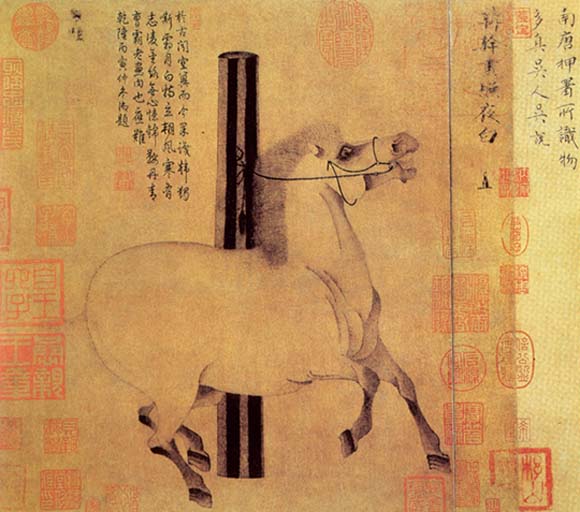
There are many many people in Cupertino who can tell you more about this holiday than I can; I’m not an expert, not even a little bit knowledgeable. I know that I was born in the year of the rat, and furthermore that I’m a metal rat (1960). Anyone born this year will be born in the year of the wood horse (2014). I’m not a great believer in astrology, but I love symbol and image, I love tradition and color and storytelling and celebrations. So, to celebrate Chinese New Year, I’m going to write a poem to a horse.
There are many poems in English about horses.
Only
A stone horse is left of his
Glory.
So, your challenge this month is to write a poem about a horse, or if you’re feeling energetic, to look up your Chinese zodiac sign and write about that. Have fun. And I wish you health, happiness, success and good fortune in the new year.
*The chrysanthemum is one of the “Four Gentlemen” (四君子) of China (the others being the plum blossom, the orchid, and bamboo). The chrysanthemum is said to have been favored by Tao Qian, an influential Chinese poet, and is symbolic of nobility. It is also one of the four symbolic seasonal flowers. (Quoted from Wikipedia. Please comment if you know more about this, or if it is incorrect.)
Cover my earth mother four times with many flowers.
Let the heavens be covered with the banked-up clouds.
Let the earth be covered with fog; cover the earth with rains.
Great waters, rains, cover the earth. Lighting cover the earth.
Let thunder be heard over the earth; let thunder be heard;
Let thunder be heard over the six regions of the earth.
— Zuni Prayer for Rain
This week the governor of California declared an emergency in our state. “California faces water shortfalls in the driest year in recorded state history.” Jerry Brown said, “We can’t make it rain, but we can be much better prepared for the terrible consequences that California’s drought now threatens, including dramatically less water for our farms and communities and increased fires in both urban and rural areas.”
This urgent news started me thinking about things I can do: take shorter showers, reprogram the irrigation system so that the lawn is watered less. Reuse water from the kitchen for house plants and the veggie garden, as much as possible. (I already drive around in a dirty car, so I can’t save water by washing it less!)
I was a high school student in Cupertino in 1977, and I remember collecting water with buckets in the shower for my mom’s azaleas. You can see more photos like the one here in SF Gate’s interesting article about drought years 1997 and 1991.

As the governor says, we can’t make rain. But what if we could? Some people pray for rain; there have been rain dances and prayers and ceremonies throughout the history of humankind on the planet. Water is more precious than gold or salt — the ultimate in life-giving elements.
Today’s prompt is to write a rain prayer poem. A rain dance song. A poem in which you celebrate rain and ask for rain to fall. There are many poems on this topic to be found in books and on the internet if you like to read to get ready to write.
Mueller’s poem is a classic sonnet form, with strict rhyme and meter, qualities is shares to some extent with the less formal Zuni prayer. The Zuni prayer also uses repetition to suggest a ceremonial style. Many rain poems have a rhythm or beat that suggests a dance or chant. Several of the poems for kids have language that imitates* the noises rain makes:
Dot a dot dot dot a dot dot
Spotting the windowpane.
Spack a spack speck flick a flack fleck
Freckling the windowpane.
(From “Rain Weather Poem” by Eve Merriam).
So! Write about rain, about its sound and feel, about its value and promise. Praise rain, dance and sing for rain. Maybe it will work.
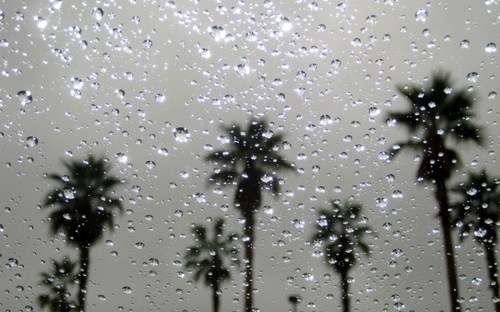
(Rainy palm trees photo credit here.)
* Bonus prize for anyone who comments with the name of this poetic technique!
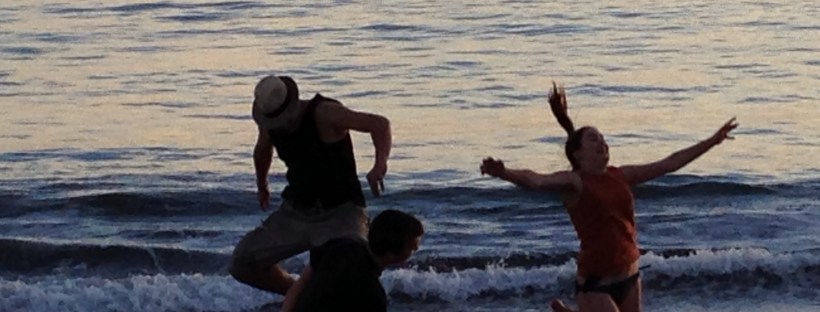
Beach Dancing
— by Jennifer and Stanley
December beach
cold sunset and sand
kids jumping
Jostled but warm
inside your purple coat
Next to my heart
where no wind blows
still sandy
Safe from the bonfire
those marshmallows blackened
and burst so fast!
Smoke and clouds
dark against year’s end light
Pounding Pacific waves
wash my paper feet
clean
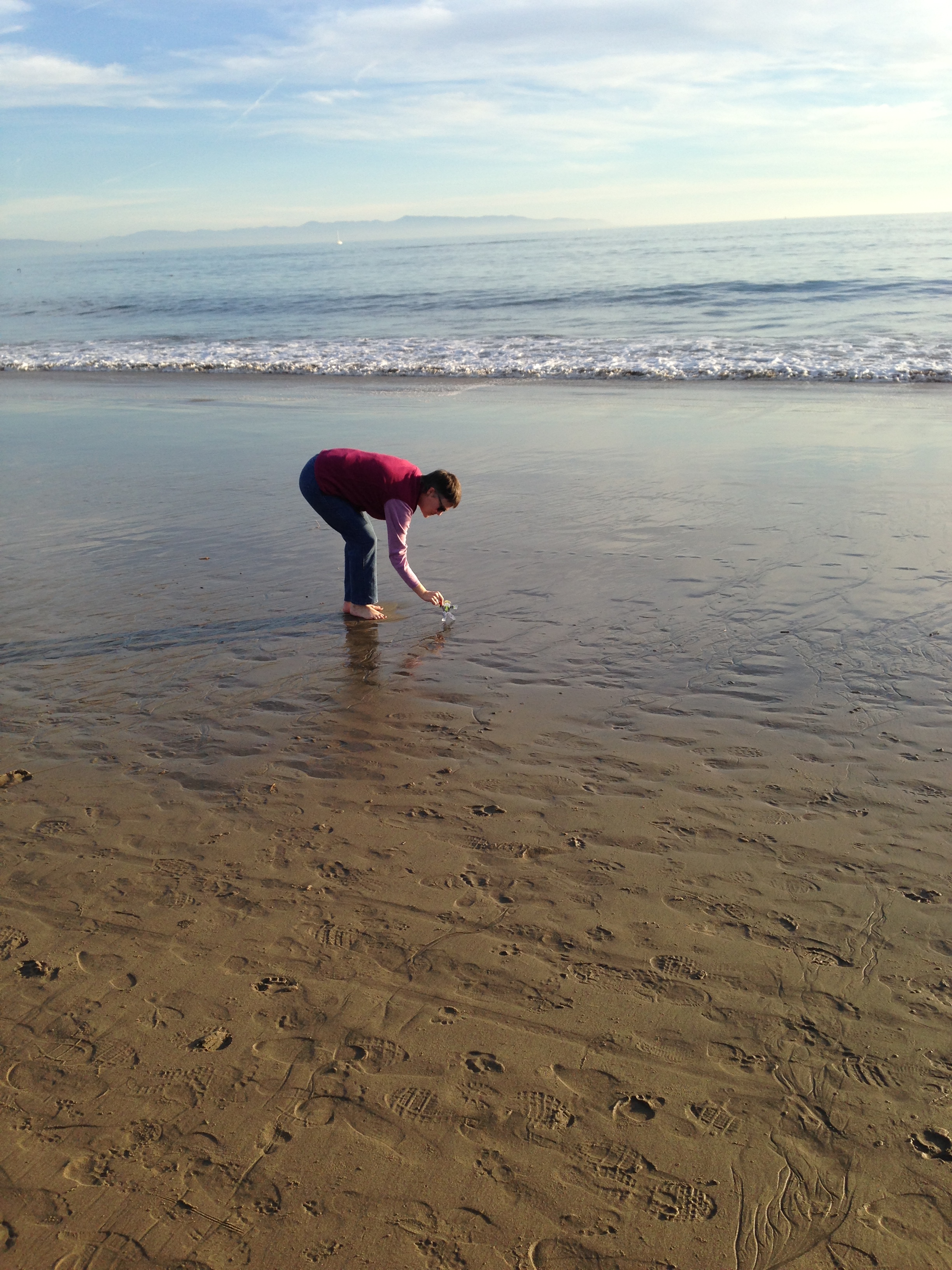
Stanley puts his feet in the ocean!
The news is finally out! David Perez will be the third Poet Laureate in Santa Clara County. Welcome David!

 David Perez Named Santa Clara County Poet Laureate
View original post 362 more words

Well, I’ve finally caved in to my (ridiculously busy) life and abandoned the “new poetry prompt on Thursday” problem. New prompts will still appear, but now they’ll appear on Saturdays. Here is the first prompt-on-Saturday. Today we are going to write rengay!
I’m not an experienced rengay poet. I love short forms (as you’ll recall from previous posts) but I’m not an expert. I have however used this form to teach before, as some kids find it wonderful to write together — it gives them a break for staring at the page alone. I hope today’s rengay prompt will get me writing something new as well as encourage you. Fortunately, there is a lot of information out there about this form, which we can all learn from.
Here’s what Michael Dylan Welch has to say: “The rengay is a collaborative six-verse linked thematic poem written by two or three poets using alternating three-line and two-line haiku or haiku-like stanzas in a regular pattern. The pattern for two people is A-3, B-2, A-3, B-3, A-2, B-3, with the letters representing the poets, and the numbers indicating the number of lines in each given verse. For three people the pattern is A-3, B-2, C-3, A-2, B-3, C-2. Unlike renku, […] a rengay stay[s] in one season and develop[s] a single theme. Since they are brief, rengay are also more easily remembered than renku, and more likely to be published in the various haiku journals. […] Rengay was first publicly introduced at the November 1, 1992 meeting of the Haiku Poets of Northern California in San Francisco.”
Rengay is a recently invented form, similar to renga, also a collaborative form of poetry from Japan. Rengay is also related to renku, a longer collaborative Japanese form.
Because rengay are long-ish, I won’t reproduce any here. Frongpond (the Journal of the Haiku Society of America) offers this sample.
I am planning to write a rengay today with my daughter. She’s agreed to collaborate with me. We are doing this in part to complete a visit of Flat Stanley to our house. I want to write a poem together with Stanley, but he’s mute on the idea. So, Stella will help and channel Stanley’s poetry onto the page.
(For anyone who’s unfamiliar with Flat Stanley, you can read more here and here and here.)
The resulting poem will also be posted on here and on Tumblr.
Have fun with your rengay and a friend. Please let me know how it goes.
Three generations of Japanese Americans reading their poetry in San Jose this month. Put it on your calendar — something to look forward to during the dark days of January.
There’s an open microphone to follow, so take your poems and be part of the experience. 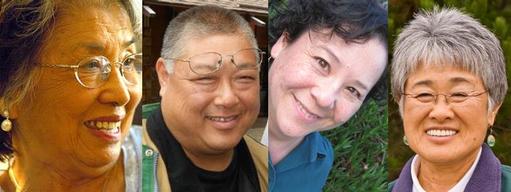

Of course, at the intersection of Silicon Valley and Poetry there will be magic. This is a great story. I am only sad I didn’t know ahead of time so I could have attended!!
Update (January 9,2014) For those who want more information, you can see examples of code poetry and a full description at this website. Click on the Resources Tab.
And, for the most intrepid among you, read Meika’s blog post here about how to tell when what you’ve got is a code poem or not. Amazing. I can barely understand this, but that doesn’t make it any less amazing. And there is even something being discussed here called Compositional Poetry. And here.
Compositional Poetry is a form of read-together poetry written in a number of voices and is performed much like a musical score, where the voices speak their lines according to their responsibilities, not in chorus, not in soliloquy, not taking turns, but all of these and none. Each voice is thus not a character as a role in a play or opera, though characters may appear of their own volition. Stories may emerge of their own inclination.
Some of these websites are delightful. Do not be afraid.
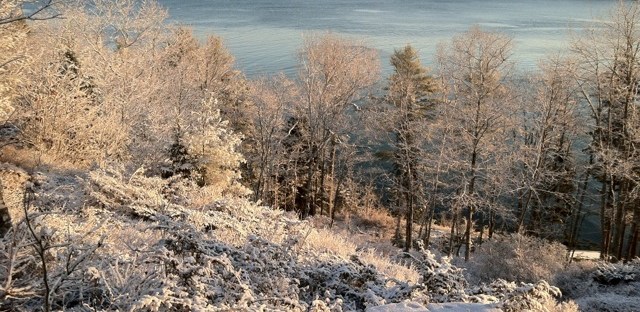
Happy New Year!
Short on time while the holiday bells of family, friends and parties are still ringing, I have been writing snatches and snippets, but no real poems. Then! I stumbled upon a delightful little (and surprisingly powerful) form called the zip.
My friend Michael Dylan Welch, the current PL of Redmond, Washington, is a renowned poet, specializing in Japanese traditional forms. You can check out his work starting with his blog Graceguts. Michael shared the news earlier this week that the English poet, John Carley, passed away after a four-year battle with cancer. Michael challenged us, as a way to celebrate Carley’s life, to write a poem in the zip format he invented. Never having heard of a zip haiku, I was intrigued!
According to a 2001 article by Carley, a zip is “proposed as an analogue to the Japanese haiku, but uses a form more suited to the innate phonic and semantic qualities of English. The zip employs fifteen syllables, two weak pauses and one strong. The poem is centred on the caesura.”
What could be better. Short poems for the crazy holiday season, or those crazy days in my PAD project when I am stuck at work late, exhausted, grumpy, etc. And a “real” form. So, I took up the challenge. I’ve written two in the past two days, and whether they are good or not, only time will tell. I love them. The first is a moment remembered from my daughter’s beach party and the second is a reflection on my mother’s upcoming birthday in Maine.
Write your own!!!
#1
making faces around the fire
beer bottles marshmallow smoke
# 2
January glittering blue and white
the shape of windows
Previous Poet Laureate of Santa Clara County, our very own Sally Ashton, is part of this interesting program. I hope I’ll see you there.
Here’s something for your 2014 calendar. Check out the Montalvo Arts Center website for full event details, but I’ll be reading with this fabulous lineup and would love to see you there:
Enjoy a night of music and poetry in the historic Villa!
The evening will include a performance by newly formed Ensemble San Francisco, poetry readings by Jeffrey Levine, poet and founder of Tupelo Press, and Sally Ashton, Santa Clara County Poet Laureate (2011-2013) and Lucas Artists Literary Fellow. Books and CDs will be available for sale. The evening begins with a small reception and cash bar.
TICKET PRICES : General: $15 | Students w/ID: $7*
Sally Ashton
Santa Clara County Poet Laureate
(2011-2013)


 Cupertino Poet Laureate