Angela Narciso Torres and Peninsula Literary

Now it is Sunday, and I have missed two days of the Cupertino Poetry Exchange. I’m not quiet sure how that happened. My apologies.

Friday I attended a lovely reading of Peninsula Literary, a quarterly reading in Palo Alto. Here’s a bit of background: “Carrie Harper Hechtman has been a curator at Peninsula Literary for six years. Her poetry  appeared recently Meridian and is forthcoming in Denver Quarterly. She holds an MFA from University of San Francisco.” The readings take place in the fine Palo Alto art gallery, Gallery House, amidst paintings by Maura Carta and ceramics by Thomas Arakawa. It’s a great place for a reading and the format is welcoming and comfortable.

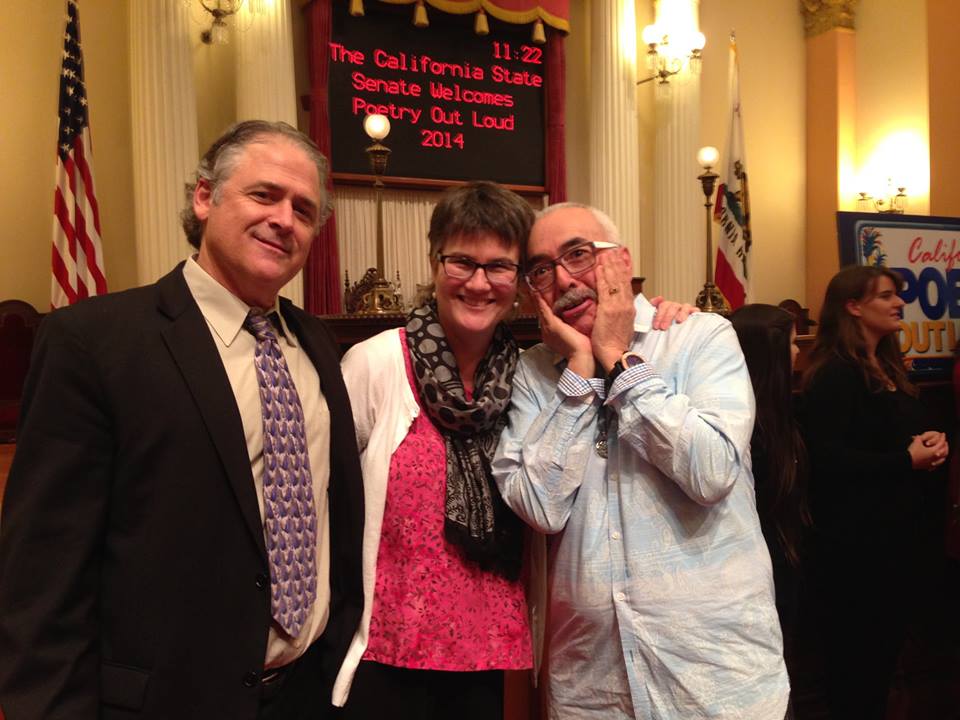
Friday’s reading featured John W. Evans, who read from his terrifying and inspiring memoir, and my good and sweet friend, Angela Narciso Torres. (The photo above is one that Angela’s son took after the reading; Angela and I with two good good friends from our old days in “The Nita Street Poets’ — a monthly writers workshop that kept us sane for several long learning years.)

I’d like to offer you Isla Mujeres, published in the DMQ Review. Please click through to read about “Waking up fevered in a foreign country, the bedclothes soaked –”  You’ll be glad you did. You can buy Angela’s book, Blood Orange, via Aquarius PressSmall Press Distribution,  and Amazon.

Image

Poem In Your Pocket Day with Love from Emily

Enjoy poems in your pockets or in your life today. You can watch videos and print poems for your pocket at the Academy of American Poets website.

My favorite poem (in my pocket right now) is Emily Dickinson’s famous “I’m Nobody”

I’m Nobody! Who Are you?

I’m Nobody! Who are you?
Are you – Nobody – too?
Then there’s a pair of us?
Don’t tell! they’d advertise – you know!

How dreary – to be – Somebody!
How public – like a Frog –
To tell one’s name – the livelong June –
To an admiring Bog!

Emily Dickinson

EMILY-DICKINSON-IM-NOBODY

Illustration by absolutely awesome artist, Susa Talan. See more of her work here.


“Midnight Approaches” — Persian poetry with music and video

This suite of seven videos (an introduction to Persian poetry, five video poem performances, and an interview with the translator) is the production of my friend, Niloufar Talebi. Niloufar is a dancer, translator, opera librettists — a woman with an enormous love for language, music and imaginative discourse.

I thought I’d take a break from “straight” poetry today and let you indulge all your senses with music and dance; listen, read, enjoy.

Of course, today is Poem In Your Pocket Day, too, but I’ll put up another post about this.

Is Today Shakespeare’s 450th Birthday? Maybe

Happy Birthday Maybe to the Bard!

Click through these links for some of Shakespeare’s most beloved poetry.

And one of my personal favorites: Sonnet 116 “Let me not to the marriage of true minds” at Poets.org.  Try reciting this one from memory a little tipsy the night before you get married.


California’s Poet Laureate Juan Felipe Herrera

Again today I am lucky in my search for a great poem and poet to share on the Cupertino Poetry Exchange. Juan Felipe Herrara is the current California Poet Laureate — and if ever there was a cheerleader for poetry, this is the guy.

Earlier this week, Central Coast Public Radio, KUSP, hosted an interview with Juan Felipe on their Poetry Show. (Can we all just pause in wonder and admiration right now for a radio show with a “poetry show”???!!!)

It’s a delightful interview and Sr. Herrera also reads a couple of his poems. So, please, take a break, listen to the interview and poetry, and if you want more information about what this amazing energizer bunny for poetry is doing, visit his website and explore his projects. Here’s what he says about his life:

I grew up on the farm worker migrant trail. Marshall Elementary in SF, San Diego High. Attended UCLA, Stanford and the Iowa Writer’s Workshop. Write in many genres. Twenty-nine books. Have received a number of awards, most recent the National Book Critics Circle Award and the Guggenheim Fellowship. Abundant gratitude to my parents, families, teachers and students on many roads. Trees, animals, rivers and clouds. Gracias.

Let Me Tell You What a Poem Brings

By Juan Felipe Herrera

for Charles Fishman

Before you go further,
let me tell you what a poem brings,
first, you must know the secret, there is no poem
to speak of, it is a way to attain a life without boundaries,
yes, it is that easy, a poem, imagine me telling you this,
instead of going day by day against the razors, well,
the judgments, all the tick-tock bronze, a leather jacket
sizing you up, the fashion mall, for example, from
the outside you think you are being entertained,
when you enter, things change, you get caught by surprise,
your mouth goes sour, you get thirsty, your legs grow cold
standing still in the middle of a storm, a poem, of course,
is always open for business too, except, as you can see,
it isn’t exactly business that pulls your spirit into
the alarming waters, there you can bathe, you can play,
you can even join in on the gossip—the mist, that is,
the mist becomes central to your existence.


I was very very fortunate to meet Sr. Herrera first at a California Poets in the Schools symposium last summer, and then to work with him again in March at the California State Poetry Out Loud Championship events in Sacramento. Here’s a photo of me (in the middle) with Brandon Cesmat (to the left, former CPitS board member) and Juan Felipe (shocked and amazed by the amazing students poetry performers and our exhaustion).

POL

You can learn more about Juan Felipe at Poets.org and PoetryFoundation.org.


“A New Song” by W. S. Merwin

Today, driving to work, feeling overwhelmed by National Poetry Month, and already stressing about what poem I would find and post to the Cupertino Poetry Exchange today, I tuned in to Garrison Keillor’s The Writer’s Almanac (on my excellent local NPR station, KALW).

Today’s poem, “A New Song” by W. S. Merwin, turns out to be a charming meditation on time and our (always impossible) expectations for it. The poem allowed me to take a deep breath, to laugh at my preoccupations with time, and to move more lightly into the day. That’s enough.

The New Song

by W. S. Merwin

For some time I thought there was time
and that there would always be time
for what I had a mind to do
and what I could imagine
going back to and finding it
as I had found it the first time
but by this time I do not know
what I thought when I thought back then

there is no time yet it grows less
there is the sound of rain at night
arriving unknown in the leaves
once without before or after
then I hear the thrush waking
at daybreak singing the new song

“The New Song” by W.S. Merwin, from The Moon Before Morning.
© Copper Canyon Press, 2014.

Because I do not have permission to reprint Mr. Merwin’s poem on my blog, I am encouraging you to buy his books by providing this link to them on Amazon. (buy now) Here is the short scoop on this wonderful poet. “Merwin was the 17th Poet Laureate Consultant in Poetry of the United States. He is the author of over fifty books of poetry, prose, and translations. He has earned every major literary prize, most recently the National Book Award for ‘Migration: New and Selected Poems’ and the 2009 Pulitzer Prize for Poetry for ‘The Shadow of Sirius.’ He lives in Hawaii where he raises endangered palm trees.”

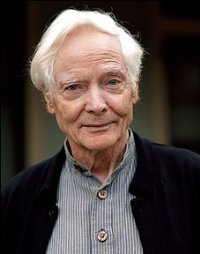
I find Mr. Merwin’s photo to be almost as calming and comforting as this poem. I hope you enjoy them both.

James Weldon Johnson’s Lift Ev’ry Voice and Sing and Handel’s Hallelujah Chorus

Time, on the poetry blog, to reflect on the close and loving relationship between song and poetry.

This song, which is not really an Easter song, still always fills my mind’s ear on Easter. James Weldon Johnson wrote the poem, “Lift Every Voice and Sing” on the occasion of Abraham Lincoln’s birthday in 1900. It was set to music composed by his brother, and became immensely popular in the black community, with some calling it the black national anthem. As an influential writer and thinker, and “with his talent for persuading people of differing ideologies to work together for a common goal, Johnson became the national organizer for the National Association for the Advancement of Colored People (NAACP) in 1920.”

liftvoice-isaacsis

Luckily for us, PBS highlights the poem and song on their Black Culture Connection page. On this page, you can listen to a great video describing the conception of the poem, the development of the song, and then a sweet and delicate version of the song, performed by the Isaac Sisters with The Relatives. (There’s also a very trippy hip-hop version in another video,by Doughboy the Midwest Maestro and DJ Kool Rod over a video montage).

Because I am a hopeless poetry researcher, I also found a very interesting lesson on this poem and song created by ARTSEDGE, from the Kennedy Center. Maybe I’ll teach with this the next time I’ve got 5-8th graders.

All that being said, I think my memories of this song stem from singing it in high school, probably in a version that sounded very much like this. (Of course, we sang it not nearly as well, nor with an organ — but with as much gusto as we could muster. And then there’s the whole thing about white middle class kids singing this in the 1970s — but that’s for another to comment on — in fact, read the comments on YouTube. I just love the song and hope you enjoy it.)

And, in case you were hoping for the Hallelujah chorus, here you go! (Mom, this one’s for you!) Happy Easter everyone!

With his talent for persuading people of differing ideologies to work together for a common goal, Johnson became the national organizer for the National Association for the Advancement of Colored People (NAACP) in 1920. – See more at: http://www.poets.org/poet.php/prmPID/72#sthash.P8oiG99M.dpuf

With his talent for persuading people of differing ideologies to work together for a common goal, Johnson became the national organizer for the National Association for the Advancement of Colored People (NAACP) in 1920. – See more at: http://www.poets.org/poet.php/prmPID/72#sthash.P8oiG99M.dpuf

With his talent for persuading people of differing ideologies to work together for a common goal, Johnson became the national organizer for the National Association for the Advancement of Colored People (NAACP) in 1920. – See more at: http://www.poets.org/poet.php/prmPID/72#sthash.P8oiG99M.dpuf

Al Young & Gabriel Garcia Marquez (PAD #28)

Al Young is California Poet Laureate Emeritus. He’s a huge spirit, a deep soul, a purposeful poet. Read one of my favorite poems by him, “Birthday Poem” at the Poetry Foundation. I love especially these last two stanzas, and especially on this day, over this weekend, when I’m remembering how the suffering of each of us, through compassion, empathy and imagination, can be remembered and experienced by all. This I see as the function of art.

How I got from then to now
is the mystery that could fill a whole library
much less an arbitrary stanza
 
But of course you already know about that
from your own random suffering
& sudden inexplicable bliss

Image

This entry on Al Young’s blog offers a variety of thoughts about and images of the late great Gabriel Garcia Marquez.

One of the delights he’s collected is this interview with Isabele Allende about how Marquez “gave us back our history” — meaning primarily the history of the people of Central and South America, but also, I think, the history of anyone who chooses to re-imagine a history other than that which is told by the conquerors.

Image

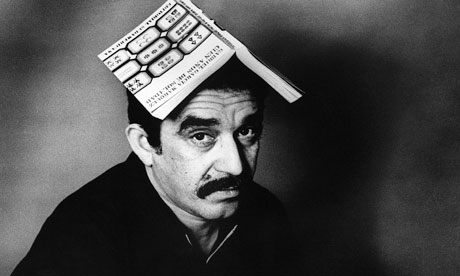
There are many photos of Marquez in the press now, some in which he’s obviously frail but sporting a lovely yellow rose in his lapel. Some show him flipping off the camera. I like this one (above). I think I understand what it means to wear a book on your head. To wander around in life, worried that those words might clatter to the ground in a pile of pages and board, to lose your mind.

Rest in peace, Sr. Marquez. Thank you for the gifts of your imagination and your hard work. Rock on Al Young, keep telling us like it is.

(For your poem-a-day prompt, try writing a poem in which you address both your random suffering and sudden inexplicable bliss. That should keep you busy.)

Good Friday with Emily Dickinson

To honor my Christian cultural tradition, I’m not posting much today, other than to share this poem of Emily Dickinson. ED wasn’t a religious poet, but her poems express the kind of spiritual inquiry that I aspire to. (The Bartleby link shows the poem as it was published first after Dickinson’s life, and edited by her publishers. The version I have here is from Johnson’s Complete Poems with reconstructed words and punctuation.)

“To know just how He suffered – would be dear –”

By Emily Dickinson

To know just how He suffered – would be dear –
To know if any Human eyes were near
To whom He could entrust His wavering gaze –
Until it settled firm – on Paradise –

To know if He was patient – part content –
Was Dying as He thought – or different –
Was it a pleasant Day to die –
And did the Sunshine face His way –

What was His furthest mind – Of Home – or God –
Or what the Distant say –
At news that He ceased Human Nature
On such a Day –

And Wishes – Had He Any –
Just His Sigh – Accented –
Had been legible – to Me –
And was He Confident until
Ill fluttered out – in Everlasting Well –

And if He spoke – What name was Best –
What last
What One broke off with
At the Drowsiest –

Was He afraid – or tranquil –
Might He know
How Conscious Consciousness – could grow –
Till Love that was – and Love too best to be –
Meet—and the Junction be Eternity


This video offers a musical rendition of the poem, with music by David Bennett Thomas, performed by The Gregg Smith Singers and organ accompaniment.

This blog has done a lovely job of presenting the poem as published initially. Click through to see.


Disobedience by A. A. Milne

For “Throwback Thursday”– and because I love this poem more than almost any other — I present to you, “Disobedience” by A. A. Milne.  My mother claims that I knew this poem by heart before I could read, certainly at two or three years of age. I believe her. It’s a great poem, and one that would appeal immensely to a child. And, most importantly, it sounds good and it’s very fun to read. Try it today! (The poem’s formatting is quirky, and I’m not going to try and fix it here –click through to The Poetry Foundation for a better look.)

Illustrations in the original book, When We Were Very Young, by the incomparable E. H. Shepard. In the illustration above, King John (and the Queen and the Prince) are saying they are very sorry to poor James.

Disobedience

By A. A. Milne

     James James
     Morrison Morrison
     Weatherby George Dupree
     Took great
     Care of his Mother,
     Though he was only three.
     James James
     Said to his Mother,
     “Mother,” he said, said he:
“You must never go down to the end of the town,
     if you don’t go down with me.”
     James James
     Morrison’s Mother
     Put on a golden gown,
     James James
     Morrison’s Mother
     Drove to the end of the town.
     James James
     Morrison’s Mother
     Said to herself, said she:
“I can get right down to the end of the town
     and be back in time for tea.”
     King John
     Put up a notice,
     “LOST or STOLEN or STRAYED!
     JAMES JAMES
     MORRISON’S MOTHER
     SEEMS TO HAVE BEEN MISLAID.
     LAST SEEN
     WANDERING VAGUELY:
     QUITE OF HER OWN ACCORD,
SHE TRIED TO GET DOWN TO THE END
     OF THE TOWN—FORTY SHILLINGS
     REWARD!”
     James James
     Morrison Morrison
     (Commonly known as Jim)
     Told his
     Other relations
     Not to go blaming him.
     James James
     Said to his Mother,
     “Mother,” he said, said he:
“You must never go down to the end of the town
     without consulting me.”
     James James
     Morrison’s mother
     Hasn’t been heard of since.
     King John
     Said he was sorry,
     So did the Queen and Prince.
     King John
     (Somebody told me)
     Said to a man he knew:
“If people go down to the end of the town, well,
     what can anyone do?”
 
    (Now then, very softly)
     J. J.
     M. M.
     W. G. Du P.
     Took great
     C/o his M*****
     Though he was only 3.
     J. J.
     Said to his M*****
     “M*****,” he said, said he:
“You-must-never-go-down-to-the-end-of-the-town-
     if-you-don’t-go-down-with ME!”

A. A. Milne, “Disobedience” from The Complete Poems of Winnie-the-Pooh. Copyright © The Trustees of the Pooh Properties, Curtis Brown Limited, London.

You can see more of my photos from my own books, at A Lane of Yellow (my Poem-A-Day image blog on Tumblr).

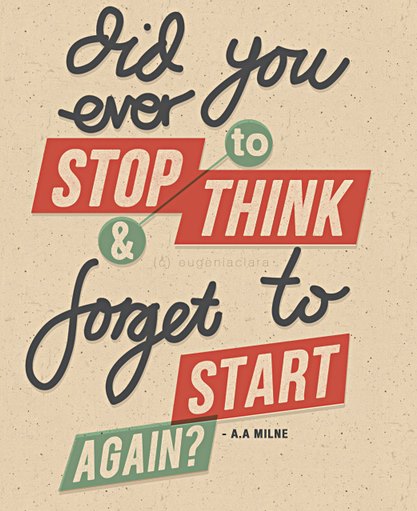
I like this following image, but I can’t confirm that A. A. Milne ever said it. Pooh talks about stopping to think, but not exactly this way. Does anyone know for sure? Of course, a good poem can always help you when you need to stop thinking.
stop to think and forget to start